Video Games in the Museum
by Jon Lackman | 5 August 2010 | Contemporary, Museums
Last February, a conference convened to discuss the “Art History of Games.” This February, a CAA session will address “Cel-Culture: The Hybrid Intersections of Art, Video Games, and Manga.” And now on view in Paris is “MuseoGames: Une Histoire à Rejouer” (“MuseoGames: A Story to be Replayed”), as ARTINFO reports:
This multimedia exhibition chronicles three decades of rapid technological advance along with the new role that video games have taken on in the home. In the “Collection” area, Atari consoles, first-generation synthesizers, and other such fossils are displayed on stands like pop-art objects … Video screens place each game into its historical context, with captions and commentary. Supported by critical and sociological analysis, the exhibition also shows the significant influence of video games on contemporary art.
Gaehtgens at the Getty
by Jon Lackman | 4 August 2010 | Uncategorized
The Los Angeles Times has written an interesting profile of Getty Research Institute director Thomas Gaehtgens. It seems unfortunate to me that they decided to bill this article as a demonstration that Gaehtgens has “quietly gained acclaim” and “gained the admiration of his staff,” when the only proof of this in the piece is two admiring quotes from people who report to him. Some outside perspective would have been nice. But it makes good reading anyway:
[In] early 2009 … he had to define priorities and slash his budget by 25%. (His annual budget is now $20 million, with a yearly acquisition budget around $2 million.) … [He] took the opportunity to make sure that most of his 175 employees — about half of whom have advanced degrees beyond college — had the chance to do real research, not just shelving books or shepherding other scholars’ projects … One example is the launch of the Getty Research Journal, an annual arts publication that includes articles by Getty staff … [A] dozen or so projects now underway are all over the map, including the history of alchemy in medieval Europe, a look at German art sales from 1920 to 1945 and a study of Latin American Surrealism.
‘Hiroshima after Iraq’
by Jon Lackman | 3 August 2010 | Books, Contemporary
Rosalyn Deutsche’s new book Hiroshima after Iraq (based on her Wellek Library Lectures) examines three contemporary video works whose subject is the 1945 nuclear bombing of Hiroshima. Its press release announces that Deutsche “reveals the passive collusion between leftist critique and dominant discourse in which personal dimensions of war are denied.” In her introduction, she writes:
Two years ago … the journal October … asked: “What, if anything, demotivates the current generation of academics and artists from assuming positions of public critique and opposition against the barbarous acts committed by the government of the United States against a foreign country?” … October’s impatience with current antiwar activity in art – and its paternal demand that younger generations identify with a supposedly authentic antiwar politics – is symptomatic of a more longstanding mood in art criticism, a mood that emerged in the late 1970s and that I have elsewhere called, following Walter Benjamin, left melancholy … [M]elancholic antiwar criticism tries to divide the subjective and the material, the public and the private, and the social and the psychic as though war has nothing to do with mental life, as though there is no work of the psyche in the waging of war. In this, antiwar criticism mimics dominant discourse about the war.
Deutsche has identified three works that she believes represent “the power of contemporary art to criticize subjectivity as well as war”:
[B]ecause contemporary art, especially since the 1980s, has stressed that work of art is not a discrete entity but, rather, a term in a relationship with viewers; because, in so doing, art has developed strategies for what Theodor Adorno called turning toward the subject; and because these strategies question the rigid forms of identity and triumphalist fantasies whose maintenance helps cause war, there is, I think, a convergence between contemporary art and psychoanalysis … I want to use these essays to explore art’s ability to combine a concern for subjectivity with a concern about the problem of war and therefore to resist both dominant and left melancholic discourses.
According to Deutsche, After Hiroshima mon amour, by Silvia Kolbowski, “challenges the myth of pure identity – individual, racial, ethnic, and national … [T]he multiplicity and uncertainty of the characters’ identities … block spectatorial identification and disidentification, which work to fix identity.”
OfLet Me Count the Ways, by Leslie Thornton, Deutsche says:
[A]s Jacqueline Rose writes about [Sylvia] Plath, Thornton, too … ‘forces the viewer to enter into something which she or he is often willing to consider only on condition of seeing it as something in which psychically no less than historically, she or he plays absolutely no part.’ In the case of Let Me Count the Ways, this disavowed something has to do with group behavior, from which no individual is immune’ …it is [an] important function of the group to shield individuals from guilt feelings by sanctioning aggressive impulses.
She turns finally to Krzysztof Wodiczko’s Hiroshima Projection:
Insisting on inadequate vision, the Hiroshima Projection belongs within a feminist practice of contemporary art that produces what have been called critical images, images that undo the viewing subject’s narcissistic fantasies, fantasies that blind us to otherness, either rejecting it or assimilating it to the knowing ego or the Same .. [C]ritical images trouble the visual field, promoting non-indifferent vision and contributing to the transformation not only of the blind eye but also of the deaf ear. Wodiczko’s Hiroshima Projection increases this transformative potential by engaging viewers in a kind of seeing – and listening – known as witnessing, an act that is crucial in our time of collective, human-inflicted, traumas, such as war and torture, that call out for witnesses … [It] also facilitates the emergence of a public sphere in which the appearance of others is prized because, questioning the social order, it keeps democracy from disappearing.
I find myself buoyed by the subtlety of her analysis, the breadth of her erudition, and the optimism of her vision. I wonder if there’s any chance that these artworks will actually do the things that she imagines they can. I wonder if her (and my and October’s) hopes – that art could stand for something, do something, make itself useful – are misplaced. It’s not that I believe that “poetry makes nothing happen” or in “art for art’s sake.” It’s that I am perpetually reminded how slippery, unpredictable, and chameleon-like artworks are. How easily the pacifist’s emblem become the tyrant’s trophy. Perhaps that doesn’t matter, perhaps it’s enough that I enjoyed the book, that it could “teach the free man how to praise.”
1 Comment
Diversity in Art History, Part II
by Jon Lackman | 2 August 2010 | Uncategorized
There are of course other kinds of diversity besides those of academic background.
When completing the U.S. government’s “Survey of Earned Doctorates” today, I noticed that it asked about race/ethnicity, and so I went online to see what the latest data was on that for art history.
Of the 207 people who received PhDs in art history, art criticism, or art conservation in 2008, 161 were U.S. citizens or permanent residents. These are the only people SED tabulates ethnicity on. Of those 161 people, zero reported themselves to be American Indian, six Asian, three Black, two Hispanic, three Other, three Multi-race, and 144 White. That adds up to 89% white.
By contrast, the PhD recipients in “Letters” (English/American literature & classics) who were citizens or permanent residents were 71% white. In philosophy, the figure is 69%; in history, 65%.
1 Comment
-
Jon Lackman said on 2 Aug 2010 at 7:01 pm:
By the way, among humanities fields, only German literature and Musicology/Ethnomusicology are more white (94% and 91%).
How to Diversify Art History?
by Jon Lackman | 30 July 2010 | Uncategorized
An article in The New York Times reports that the Mount Sinai medical school admits a certain number of students each year who don’t have the traditional credentials (high MCAT scores and extensive coursework in biology, chemistry, and physics). This hampers the school’s U.S. News ranking, and a small percentage of these students subsequently drop out, but the rest of the students seem to fare as well as conventionally trained applicants, and they help diversify the nation’s pool of doctors.
I think the art history field would benefit similarly were its graduate programs to recruit and admit a greater number of unconventional students. Admissions committees everywhere seem to focus on the same criteria — g.p.a., test scores, the number of college art history courses taken, and recommendations from respected figures in the field — as the best predictors of how well students will do in coursework and how likely they will be to stick around for the PhD. These criteria have validity, but they exclude some highly creative individuals who don’t score well on traditional measures and don’t have extensive background in art history but have the capacity to make a big impact on the field.
Note that many undergraduate institutions have anemic art-history departments (that may or may not even offer a major in art history). Even undergraduates with access to a good department may not discover it until late in their college career, particularly when their high school education and hometown museum offerings did little to ignite their interest in art history.
Art history graduate schools are going to have to get creative if we’re to have any hope of diversifying the field. As things stand, the population of graduate students seems to be composed overwhelmingly of wealthy white students who grew up with regular access to art and/or attended the private high schools that offer (or even require) art history courses — a population that, despite its merits, doesn’t have the widest possible set of experiences and perspectives.
2 Comments
-
Mary Trent said on 2 Aug 2010 at 3:41 am:
Thanks for this great post.
The PhD program in Visual Studies at University of California, Irvine has some of this diversity in its grad students. Students come in with Art History and Film and Media Studies backgrounds, but also Sociology, Science Studies, American Studies, Gender Studies, and others.
The Irvine PhD program is interdisciplinary in nature (the faculty sit in the Art History and Film and Media Studies departments), which helps. But, visual studies is also a discipline more open to such diversity than art history has been traditionally.
I would imagine this diversity may also be found in Rochester’s Visual Culture program.
-
Katy Crocker said on 10 Aug 2010 at 3:37 am:
Thank you for this comment, Mary. It is very informative? Are you currently involved with University of California, Irvine?
Art Critics & Historians For Hire
by Jon Lackman | 29 July 2010 | Contemporary
On The Huffington Post, Daniel Grant writes:
For some time, the ground has been shifting, moving the line between what is and is not considered acceptable for artists to pay for … Critics, museum curators and art historians regularly are approached by artists to write catalogue essays; for some of them, it is a lucrative sideline, since the going rate is one or two dollars per word and essayists often require a minimum of 1,000 words (critic Peter Frank claimed that also may be “an extra charge if the writing needs to be turned around quickly”). The New York City-based artist career development company, Katharine T. Carter & Associates, has formalized his process, placing on retainer a number of New York area art critics who for two dollars per word, 600 words minimum, will write catalogue essays … Artists need to keep their hopes and expectations in check, when hiring a noted critic. Just because Richard Vine, the managing editor of Art in America and another of Katharine T. Carter’s critics, wrote about a given artist does not mean that artist has any “in” with the magazine — in fact, none of the artists he has written up as part of his association with Katharine T. Carter has ever been reviewed or profiled in Art in America. “You have to realize that you haven’t bought this person body and soul for the price of an essay,” Eleanor Heartney said, adding that “all of us who write these catalogue essays are trading on our reputations.”
I’ve heard the rumor, several times, that some art critics accept free or discounted works from artists (or their galleries) whom they review favorably, although I’ve never seen the proof to back it up.
2 Comments
-
Katy Crocker said on 31 Jul 2010 at 6:57 am:
Can critics, who offer services for hire, still consider themselves critics? What then is the distinction between writing a critical essay, and getting paid $2/word to write about an untalented artist?
-
Karen Leader said on 1 Aug 2010 at 12:09 am:
Although there is no real means of enforcement, art historians accepting works of art from artists about whom they have written are breaching professional ethics. Here is what CAA’s Standards and Guidelines says on the matter:
C. A more difficult situation is one in which an art historian is offered the gift of a work of art by an artist who is a friend, or about whom he or she will be writing or has written. There is no question but that in most cases the art historian’s publication about the artist will contribute to the increased value of his or her work, as well as of the art historian’s gift. The art historian is then placed in a situation where questions of conflict of interest can be legitimately raised. The tactful but outright refusal of gifts from artists may be frustrating, but such practice insures integrity of the process and should not incur loss of respect from the artist. To have works of art given by artists to members of your family similarly creates a conflict of interest.
‘The Warburg Institute is fighting for its life’
by Jon Lackman | 28 July 2010 | Uncategorized
The Art Newspaper editor Anna Somers Cocks writes:
[In 1944 London University agreed to] “maintain and preserve the Warburg Library in perpetuity, provide it with a suitable building near the university centre and keep it adequately equipped and staffed” … So why is the Warburg fighting for its life against London University? … There are now fears that the University plans to move the Warburg’s library from its building in Woburn Square and put it with its own library in its headquarters. In 2007 it squeezed the Warburg by raising its space charge by £500,000, which eats up half the Institute’s £1.3m annual grant so that it now has an annual deficit of half a million … The University is also trying to curtail the Warburg’s independence after “converging” the administration of the Warburg library into London Research Library Services, which will be appointing the Warburg’s next librarian, who will no longer be a scholar-librarian, as has been the case from Fritz Saxl onwards. There is no money to appoint a successor to the head of the Warburg’s photographic archive, the essential complement to the books in the integrated Warburgian approach to ideas … All this suggests that the University does not acknowledge its obligations under the 1944 trust deed, but what is almost more serious is that in its bureaucratic way the University seems to have lost sight of the human reality of what makes a place of learning and intellectual creativity. Administrative synergies will not do it; money and a fine building do not necessarily do it, as the Getty Research Institute has shown. Despite all its facilities, that has never stirred people’s minds much or aroused affection. The Warburg, on the other hand, attracts scholars from all over the world and from many fields. They congregate around its books, each floor with its own theme: basement and first floor, Image; second floor, Word; third floor, Orientation; fourth floor, Action. Action, for example, embraces social history, political history, magic and science, while Orientation is western and eastern religion and philosophy. Ideas seem very accessible, almost tangible here.
1 Comment
-
Ben said on 29 Jul 2010 at 5:50 pm:
The description of the idiosyncratic arrangement of the books by theme reminds me somehow of the Barnes Foundation’s eccentric curatorial vision — more evidence for the unique value of individual judgment.
Hypothesis: institutions and collections created by quirky millionaires are more interesting and valuable than equally well-funded institutions created by armies of sober nonprofit employees.
Tilting at Towers
by Jon Lackman | 28 July 2010 | Architecture
From The Telegraph:
Professor John Burland has spent the last two decades striving to save – and understand – the Leaning Tower of Pisa. After defying gravity, Italian bureaucracy and accusations of corruption, it seems he’s finally cracked the case … By a quirk of local geography, Pisa’s water-table rose higher on the tower’s north side, often reaching within one foot in rainy season, and this gave the tower an annual ratchet southward. Armed with this vital information, in 2003, Burland introduced a new drainage system beneath the piazza’s north side, one that lowered and stabilised the water-table, so there’s no kick in either direction. Problem solved. The inclination continues to be monitored daily by the OPP and new figures reveal that the tower didn’t move at all between 2003 and 2009. ‘It’s stopped leaning completely …’ says Burland with a mixture of pride and relief. The Pisans, though, are a hard people to please. Some accuse Burland et al of sterilising their tower – for, part of its old mystique had been the possibility it might collapse at any moment, the frisson that a voyeuristic visitor might witness such a fall. ‘You can’t please all of the people all of the time,’ Burland shrugs … ‘It’s amazing that the Tower of Pisa should remain so fashionable, even at 800 years old,’ Burland smiles. Not bad for a building that was never meant to lean to begin with.
Judge: Art caused ‘psychological trauma’
by Jon Lackman | 27 July 2010 | Contemporary
From The Moscow News, an update to the story of the censored curators:
Moscow’s Tagansky District Court convicted prominent museum curators Yury Samodurov and Andrei Yerofeyev of “inciting hatred and denigrating human dignity” by staging a controversial art exhibit – but allowed them to avoid a jail term, ordering them instead to pay 350,000 roubles ($11,500) in fines. The verdict held that the exhibition subjected Christians to “psychological trauma,” “moral suffering” and “denigrated their human dignity”. Judge Svetlana Aleksandrova also slammed the curators for their “cynical, reckless attitude toward the religious feelings of Orthodox believers” in knowingly selecting artwork previously banned from public display.
Günter Behnisch 1922-2010
by Ben Lima | 27 July 2010 | Architecture
The architect Günter Behnisch, who designed the 1972 Olympic Park in Munich together with engineer Frei Otto, died July 12th in Stuttgart, at the age of 88. (more…)
1 Comment
-
Sami Elafi said on 28 Jul 2010 at 1:27 pm:
Deconstructivism seems to be the word of choice whenever we come across a building with a twisted order. You can’t help it but to wonder why DERRIDA him self didn’t reject the association between Deconstruction in Philosophy and what has come to be known as Deconstructivism in Architecture. He knew that his word is capable of prompting Morphological impressions, not only that, some ugly ones too. That’s why he always insisted that Deconstruction is not Destruction. I can say that it’s an attempt to distinguish between the interest in the Exteriority of a Phenomenon, which what the word Destruction denotes, and his deconstructive method which is purely historical.
Deconstruction is a method by which one can grasp Phenomenon; be it an Object, a Text or even Human Subjectivity. The method starts from the presumption that every Phenomenon has a history. In order to grasp any of that one has to read through the different layer that might have constructed this history in the first place. In Deconstruction reading takes various strategies mostly derived from various conflicting philosophical doctrines. What Deconstruction does is to reconcile such conflicts by presenting the various strategies as affirmative rather than dismissive of one another.
In Architecture the method was supposed to be used not just for reading but also for writing; that is the making of Architecture. I don’t see anything wrong with that because in Deconstruction oppositions are affirmative and not dismissive. This is to say that reading in some ways is writing. But what I find unsettling is the linking of Architectural motifs such Ordered Chaos or Fragmentation with Deconstruction. Being deeply entrenched in Methodology I See that as far as Architecture is concerned Deconstruction is to do with the Program of Architecture and not the straight forwardness in negotiating Morphology. As a matter of fact I can see no reason why can’t a Bauhaus building be based on Deconstructivist Methodology. Now if we are so interested in labeling styles and in this particular incident the work of GÜNTER BEHNISCH I suggest why not try Expressionism, I believe to large extent this is a theory of Morphology. And maybe a comparison between HANS SHARON and GÜNTER can be the relevant thing to do in this respect.
‘Russias! Memory, Mystification and the Imaginary’
by Jon Lackman | 23 July 2010 | Contemporary, Modern, Museums
In the Financial Times, Rachel Spence praises the little known exhibition “Russias! Memory, Mystification and the Imaginary,” now in its final days in Venice:
As the 1930s unrolled in a psychotic rollercoaster of purges and famines, Stalin bullied artists, filmmakers, writers and musicians into making work that supported the fantasy that this was the best of all possible worlds … Although from the 1960s onwards so-called “underground” artists did explore styles – abstraction, surrealism – condemned by the party as decadent, true liberty of expression came only with the fall of communism. It is rare to see this poignant history mapped out in a single exhibition. That Russians! Memory, Mystification and the Imaginary achieves this feat with clarity and grace is partly a credit to the curators, Silvia Burini and Giuseppe Barbieri, and partly a testament to the diverse yet complementary passions of two Italian collectors, Alberto Sandretti and Alberto Morgante, on whose holdings the show is based … Numbering a staggering 22,000 works and encompassing avant-garde, socialist realism and unofficial styles, Sandretti’s collection is indicative of a breed who had indiscriminate enthusiasm for all things Soviet … Alberto Morgante’s collection has different ideological origins. Concentrating on avant-garde and underground art, it was purchased almost entirely through Franco Miele, an art critic.
However, an article in ARTnews by Konstantin Akinsha argues that “many of the works attributed to Russian masters … are not what they’re claimed to be”:
[B]oth collections were previously unknown, and scholars and experts in the field of the Russian avant-garde are puzzled by the avant-garde art on view. The names are familiar: Chagall, Kandinsky, Malevich, Lissitzky, Tatlin, Goncharova, Larionov, and so forth, but the pictures in many cases don’t match the labels. Experts in the Russian avant-garde, a field in which fakes abound, are particularly concerned with provenance and are suspicious of any work that was not exhibited or published during the lifetime of the artist said to have created it … [One] previously unknown work is Girl with Goat, attributed to Marc Chagall and dated 1911. ARTnews brought this picture to the attention of the Paris-based Marc Chagall Committee, which branded it an “obvious fake” (faux évident).
This Alibi Online review has images.
What Makes a Genius?
by Jon Lackman | 22 July 2010 | Awards, Books, Renaissance
A Virginia newspaper, The News Leader, profiles UVA professor Cammy Brothers, whose book Michelangelo, Drawing, and the Invention of Architecture recently won the Charles Rufus Morey Book Award from the College Art Association and the Alice Davis Hitchcock Book Award from the Society of Architectural Historians:
Michelangelo stands apart from his contemporaries. But is he a genius, as his historical legacy would have us believe? … Brothers counters the commonly held notion of genius as a function of spontaneity, which Michelangelo himself set forth. He encouraged the idea that he never studied with anyone, and that his gifts just came to him naturally. Brothers argues, “What we see in his drawings – and the same can be said about Leonardo – is that there is actually evidence of tremendous labor. There is a huge amount of work that goes into anything he comes up with and the drawings document that in a way that the finished works cannot.” The drawing evidence also counters the idea of genius as having an endless supply of ideas that “crop up in a spontaneous manner.” Michelangelo kept his drawings as an archive “from which he keeps drawing. He goes back to old ideas revising them and repurposing them,” she said. In the book, Brothers focuses on two aspects of Michelangelo’s work – the relation between the drawings he made of the human figure and his architecture, and what these drawings, considered together, reveal about Michelangelo and his way of thinking. Looking at different aspects of an artist’s work together is rare for art historians. In Michelangelo’s case, that means they would be examining either his paintings, sculptures or architecture, Brothers said, but rarely two or three of those genres together. Another rarity is to study architectural drawings removed from the investigation of what they reveal about the built architectural work … “What is unusual about my work is that I was interested in the drawings for their own sake, in terms of what they reveal about Michelangelo’s way of thinking,” she said … Brothers’ next project will focus on the work of Giuliano da Sangallo.
Conserving Wisdom
by Jon Lackman | 21 July 2010 | Conservation
The L.A. Times recently did a piece on the ongoing diagnosis of the Ghent Altarpiece:
Anne van Grevenstein, an art conservator who teaches at the University of Amsterdam, along with Ronald Spronk, an art historian from Queen’s University in Ontario, Canada, head a team of art experts and trainees conducting a detailed technical analysis of the work, a project funded by a $230,000 grant from the Panel Paintings Initiative of the Getty Foundation … Eventually, the material collected will be put online for other scholars to study. “It seems logical to do,” says Spronk, “but I don’t think it’s ever been done” … At the end of 2008, the foundation launched the Panel Paintings Initiative and set about identifying projects in need of funding — both to help the conservation of noted work but also to help train a new generation of conservators. Conservation of paintings on wooden panels is a highly specialized field, restricted to perhaps a dozen people in the world. “We realized that most of those current experts will retire within the next decade,” says [Getty Foundation director Deborah] Marrow.
Meanwhile, the Philadelphia Inquirer tells a story of conservator training paying off:
“An Eakins Masterpiece Restored: Seeing ‘The Gross Clinic’ Anew,” an exhibition featuring the just-restored painting, opens at the [Philadelphia] Art Museum’s Perelman Building Saturday … The Gross Clinic, now owned jointly by the Art Museum and the Pennsylvania Academy of the Fine Arts, has received the most extensive and informed restoration in its history, an astonishing effort led by [Mark S.] Tucker, now 55, the museum’s vice chair of conservation and its senior painting conservator. The restoration was made possible by a massive public effort in 2006, led by the academy and the Art Museum, to raise $68 million and buy the work when Jefferson [Medical College] announced its intent to sell it to a pair of out-of-town museums … Julie Berkowitz, former university art historian at Thomas Jefferson University, said she was “dazzled by the conservation” work done by Tucker and his team … It has taken decades to accumulate the experience and information to bring off the feat, and no one has had more experience with Eakins than Tucker.
Okwui Enwezor Critiqued
by Jon Lackman | 20 July 2010 | Africa, Conferences, Contemporary, Museums
Tolu Ogunlesi’s review of Art Basel alerted me to a recent provocative essay by professor and Aachron Editions publisher Sylvester Okwunodu Ogbechie, “The Curator as Culture Broker (A Critique of the Curatorial Regime of Okwui Enwezor in the Discourse of Contemporary African Art),” which he recently presented at a UC-Santa Cruz conference The Task of the Curator: Translation, Intervention and Innovation in Exhibitionary Practice:
Enwezor’s curatorial focus is … African artists who live and work in the West … [He] produces ahistorical interpretations of contemporary African art in general … advancing a very self-referential narrative of contemporary practice using limited number of artists recycled in closed-loop exhibitions. Enwezor’s curatorial intervention is also built on a notion of globalization that assumes the free flow of cultural producers: however, this notion is patently false … Consider [the] ongoing transformation of African studies in the American academy: almost all academic positions focused on African art history are now being offered to scholars of the African Diaspora, and the field faces an increasing reluctance by researchers to conduct “Africa-focused” research in Africa. Consider also that museum collections devoted to contemporary African art are primarily filled with artworks from African artists based in the West … Enwezor came to curating from a rather undefined background with negligible training in African art history but with an active engagement with New York art of the 1990s … Enwezor’s various publications show large gaps in his understanding of art history and African art history in particular. Furthermore, Enwezor’s elevation (and in fact, the elevation of African curators in general within the American discourse of contemporary art) served to displace African American artists and art activists who were, at the beginning of the 1990s, starting to demand greater representation at the table. Shifting attention to African curators allowed the mainstream art establishment to completely cut out these bothersome African Americans. The fact that Enwezor has largely not collaborated with these African American curators and critics speaks volumes about his own complicity in this process of marginalization … Africa is also being renewed in response to the challenges of modernization and globalization. We must try to understand its unique responses to these processes rather than try to impose the aesthetic preferences of contemporary Western art on it. Enwezor has clearly failed on this front and his curatorial practice should now be subject to a formal criticism that is so far lacking.
Along the way, Ogbechie also has some choice words for contemporary curators generally:
In the run up of the economic bubble, hedge fund managers in particular became star figures of pop culture by leveraging financial brokerage to stratospheric levels and manipulating financial information to create newer and more esoteric financial instruments that yielded greater levels of profit. The move away from the “basic labor” of banking and money management into this rarefied field of financial information brokerage provides a parallel to the rise and role of the curator in contemporary practice … [W]hereas artists in the era of modernism claimed an avant-garde status and the authority to define the horizon of meanings of their work, contemporary curators have by and large usurped this role … [T]he contemporary curator is a culture broker in pretty much the same way a hedge-fund manager brokers financial instruments … It suggests that curators benefit from their work in a manner completely out of proportion to the value of their input.
His essay appears to be attracting notice.
As far as I know, Enwezor has not (yet) responded.
For a review of Ogbechie’s talk and the conference generally, read this account by PhD student Johanna Gosse.
1 Comment
-
Travis Nygard said on 22 Jul 2010 at 6:14 am:
After reading Sylvester Okwunodu Ogbechie’s analysis I was left with the feeling that he is angry about something that went unstated. It is legitimate to debate the merits of continental versus diasporic definitions of Africa, and I agree that Enwezor has often focused on the diaspora. I don’t, however, think it is fair to scapegoat Enwezor’s work as a regime that disempowers both African artists and African American scholars. No one curator or scholar has that much power. Instead I see Enwezor as someone who is to be commended for his work to open up dialogues across cultures. The claim that Enwezor is “legitimizing a notion of Africa that dispenses with the continent itself as a historical theater of contemporary art and visual culture engagements” seems particularly hollow to me, given that one of his major exhibitions was the Johannesburg Biennale of 1997. Similarly, the idea that Enwezor focuses almost entirely on the west is dubious, given that his innovative approach to Documenta 11 was to host conversations about contemporary art across the world—including in New Delhi and Lagos. Full disclosure: I took two courses from Enwezor in graduate school, but I have only heard Ogbechie speak once.
‘American art collectors ripe for study’
by Jon Lackman | 19 July 2010 | Uncategorized
More on the history of American collectors from the L.A. Times:
With names like Morgan, Getty and Huntington attached to impressive collections available for public view, the history of art collecting in America has acquired a new level of scholarly scrutiny … Art historians tend to concentrate on connoisseurship and aesthetics. That’s beginning to change. Thanks to expanding views of art history, a fresh crop of scholars intrigued with the socioeconomic context of collecting and the provenance of art objects are giving American collectors a new level of scrutiny and respect. “The history of collecting is so deliciously interdisciplinary,” says Inge Reist, who directs the fledgling Center for the History of Collecting in America at the Frick Collection in New York … So far, the archives directory encompasses about 5,000 collections in 500 repositories documenting the lives and activities of 1,500 American collectors … The Getty Research Institute, established in 1982, has a much broader reach than the Frick center, but its special collections contain an expanding trove of letters, business records and libraries of American collectors, dealers, artists and critics. The enormous archive of Joseph Duveen, the dealer known for selling the collections of impoverished Europeans to fabulously wealthy Americans, including Frick, Huntington and Mellon, is in great demand, says Marcia Reed, chief curator and head of collection development at the Getty’s research library.
Why all the interest in the history of collecting? Is it related to the prominence of contemporary collectors? Some would even say preeminence. In the opinion of individuals such as collector Adam Lindemann, “declining budgets mean that the world’s leading museums, once the bastions of art, can no longer compete with deep-pocketed collectors.”
In the papers
by Ben Lima | 18 July 2010 | Uncategorized
Recently in the press:
- The Education of the Virgin (c. 1617), in the collection of the Yale University Art Gallery, has been reattributed by curator John Marciari to Velázquez. See Marciari’s article in Ars Magazine (full text not online); The Guardian; Los Angeles Times; El Pais.
- “Fra Angelico to Leonardo: Italian Renaissance Drawings” at the British Museum, reviewed by James Hall in the TLS
- On Leonardo’s Virgin of the Rocks: Jonathan Jones in the Guardian
- On connoisseurship and the controversial “forensic art expert” Peter Paul Biro: David Grann in the New Yorker (16000 words)
- Also on connoisseurship and attribution: “Close Examination: Fakes, Mistakes and Discoveries,” an exhibition at the National Gallery (London) reviewed by the Economist and by Peter Campbell in the LRB
- Photography: book reviews of Henri Cartier-Bresson, Bernd and Hilla Becher, Wolfgang Tillmans, and Andy Grundberg’s essay collection Crisis of the Real: Jackie Wullschlager in the Finanical Times
- On Andrew Graham-Dixon, Caravaggio: A Life Sacred and Profane, in the Economist
- Kevin Starr, Golden Gate: The Life and Times of America’s Greatest Bridge, reviewed by Herbert Gold in the WSJ
Collection as Emancipation
by Jon Lackman | 16 July 2010 | Books
Also in caa.reviews recently, Laura R. Prieto reviewed Dianne Sachko Macleod’s Enchanted Lives, Enchanted Objects: American Women Collectors and the Making of Culture, 1800–1940:
It is an open secret that many museums, large and small, owe the strength of their collections to women patrons, yet few scholars to date have studied women as serious art collectors and tastemakers … Macleod traces the arc of women’s involvement in collecting. What originated as a solitary pursuit in the early nineteenth century blossomed into a Gilded Age social performance. It then transformed gender expectations at the turn of the twentieth century … In Macleod’s conception, collecting art was a sort of consumption that led to psychological and emotional empowerment … Whereas market-driven mass consumption might co-opt women’s desires, the purchase and control of art objects ultimately gave women access to “the male discourse of possessive individualism” (45). Some then projected their emancipation outward to the built environment, the staging of world’s fairs, suffrage advocacy, and philanthropy … [Macleod's] interdisciplinary approach ultimately relies most on psychoanalytic theory, especially the concept of transitional objects and the well-established psychological significance of play. Macleod argues persuasively that collecting could be imaginative, creative play, from a manifestation of desire to an act of reverie … An underdeveloped aspect of the study is the role of class and race in collecting … Enchanted Lives, Enchanted Objects will captivate scholars in many fields, from material culture and American studies to women’s and gender studies. This is not only a book whose physical beauty will grace the shelves; Macleod raises fascinating questions about the connection between art and subjectivity.
A ‘Colossal’ Text
by Jon Lackman | 16 July 2010 | Ancient, Architecture, Books
In caa.reviews, Thomas J. Morton considers a new book by Katherine E. Welch:
The Colosseum, more than any other building from ancient Rome, is routinely the subject of both scholarly and popular texts. While it seems that important studies are published on this structure every year, rarely does any attain the status of definitive text. Katherine Welch’s The Roman Amphitheatre: From Its Origins to the Colosseum is such a book. Welch’s splendid volume is a culmination of her amphitheatre studies and provides a much-needed examination of the building type’s origins in Republican Rome and its development up to and including the Colosseum.
FRENCH COMICS: “NOT JUST FOR CHILDREN”
by Karen Leader | 15 July 2010 | Books
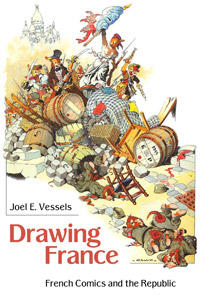
[A review of Joel E. Vessels, Drawing France: French Comics and the Republic (Jackson: University Press of Mississippi, 2010)]
This is an ambitious attempt to weave a thread that connects French politics, cultural policy, and nationalism, from the “golden age of caricature” through the “golden age of BD [bande desinée].” Stops along the way include a clarifying section on Philipon and l’affaire de la poire that forever enshrined Louis-Philippe in pyriform; the nauseating muck through which some anti-Semitic illustrators slogged during the Dreyfus affair; and the superior and influential satire of L’Assiette au Beurre. Starting with Philipon is strategic, because it was then that the demand for special scrutiny of images, which “strike the sight” and stir up passions “without reasoning,” was hatched in the chambers of state power. Despite its seductive full-color cover, an anthropomorphized recreation of Delacroix’s Liberty Leading the People by the artist Calvo, Vessels’ book contains few illustrations and little discussion of the technique, style, or aesthetics of French graphic humor. This is not a criticism, just a warning.
Having established a nineteenth-century foundation, Vessels then narrows the focus onto la presse enfantine, the true birthplace of modern day BD. Concern over the well-being of les enfants pits Communists against Catholics, entrepreneurs against anti-Americanism, Tarzan against “true France,” Vichy against, well, everything, and, censorship against republican values, seemingly in perpetuity. Somewhere along the way, BDs become “not just for children anymore” and if I have one gripe it is that the author could have dealt more critically with the ramifications of this development.
Vessels, channeling the dictum of historian Richard Kuisel that “the evidence must always speak for itself,” (ix) offers an exhaustive history of the bureaucratic maneuvers, propaganda battles and continual re-definitions of cultural patrimony that would define, restrain or promote BDs as authentically French. Visit the festival for bédéphiles in Angoulême, or survey the prices garnered for Tintin memorabilia, and you will think the story is settled. I wouldn’t count on it. Incidentally, if this is an area of interest, I recommend the site Caricatures et Caricature.
‘Artefakt’
by Jon Lackman | 15 July 2010 | Journals
If you read German, I recommend the young online magazine Artefakt, published by beginning and advanced students (and alumni) of the Institute of European Art History at the University of Heidelberg. In recent issues, contributors interviewed a Frankfurter Allgemeine Zeitung editor about the state of art criticism, artist Derek Ogbourne about his work, and an art librarian about the changing landscape of print and online publishing. Another article reviewed several of the new online and open-access scholarly art-history journals to have appeared recently.

Thank you for your review of this text. I’m currently researching Deutsche’s work with regard to the public and private experience of wearable art and found your presentation of her latest text very interesting.