FRENCH COMICS: “NOT JUST FOR CHILDREN”
by Karen Leader | 15 July 2010 | Books
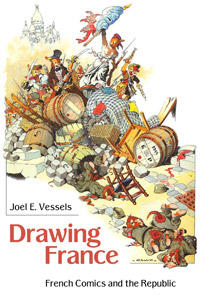
[A review of Joel E. Vessels, Drawing France: French Comics and the Republic (Jackson: University Press of Mississippi, 2010)]
This is an ambitious attempt to weave a thread that connects French politics, cultural policy, and nationalism, from the “golden age of caricature” through the “golden age of BD [bande desinée].” Stops along the way include a clarifying section on Philipon and l’affaire de la poire that forever enshrined Louis-Philippe in pyriform; the nauseating muck through which some anti-Semitic illustrators slogged during the Dreyfus affair; and the superior and influential satire of L’Assiette au Beurre. Starting with Philipon is strategic, because it was then that the demand for special scrutiny of images, which “strike the sight” and stir up passions “without reasoning,” was hatched in the chambers of state power. Despite its seductive full-color cover, an anthropomorphized recreation of Delacroix’s Liberty Leading the People by the artist Calvo, Vessels’ book contains few illustrations and little discussion of the technique, style, or aesthetics of French graphic humor. This is not a criticism, just a warning.
Having established a nineteenth-century foundation, Vessels then narrows the focus onto la presse enfantine, the true birthplace of modern day BD. Concern over the well-being of les enfants pits Communists against Catholics, entrepreneurs against anti-Americanism, Tarzan against “true France,” Vichy against, well, everything, and, censorship against republican values, seemingly in perpetuity. Somewhere along the way, BDs become “not just for children anymore” and if I have one gripe it is that the author could have dealt more critically with the ramifications of this development.
Vessels, channeling the dictum of historian Richard Kuisel that “the evidence must always speak for itself,” (ix) offers an exhaustive history of the bureaucratic maneuvers, propaganda battles and continual re-definitions of cultural patrimony that would define, restrain or promote BDs as authentically French. Visit the festival for bédéphiles in Angoulême, or survey the prices garnered for Tintin memorabilia, and you will think the story is settled. I wouldn’t count on it. Incidentally, if this is an area of interest, I recommend the site Caricatures et Caricature.
