Touching Art: Video Paintings
by Leslie Thompson | 19 April 2010 | Contemporary, Museums
With the integration of technology and electronic media in art, new issues in contemporary art continue to arise. A recent encounter with such type art has raised a particular question for me.
The Modern Art Museum of Fort Worth currently has on view a FOCUS show of American-born artist Ben Jones:
Jones’ work investigates new methods of pictorial storytelling in the digital age. An interdisciplinary artist working in video, sculpture, painting, light painting and drawing, his artworks and installations evoke environments and themes both familiar and bizarre.
In one of the galleries hangs MS Video Painting II, 2010 (canvas, gouache, DVD), a canvas painted in a somewhat op art fashion with stripes and flat shapes , a completed work in itself. Suspended opposite the canvas is a projector that projects moving designs in light, altering the appearance of the painted composition. Thus the canvas becomes a different work of art. (Edit: Both images courtesy of Amanda Potter’s iPhone.)
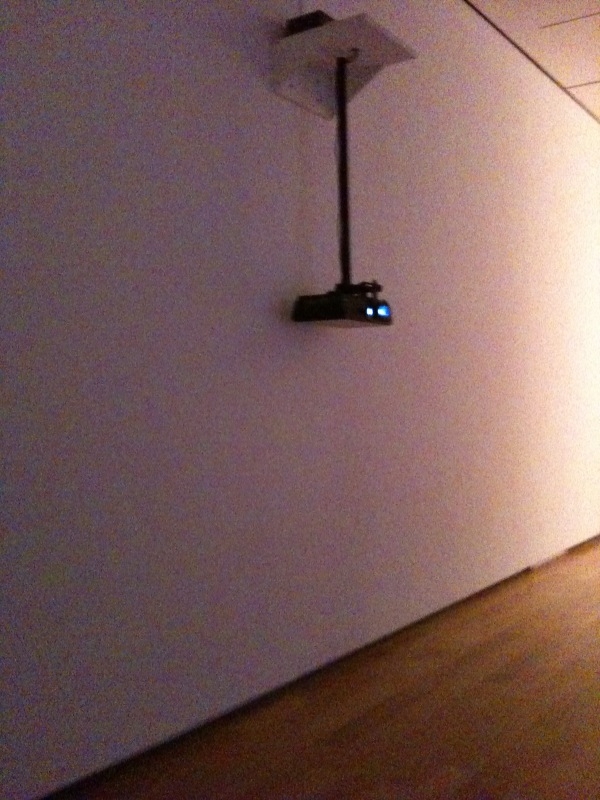
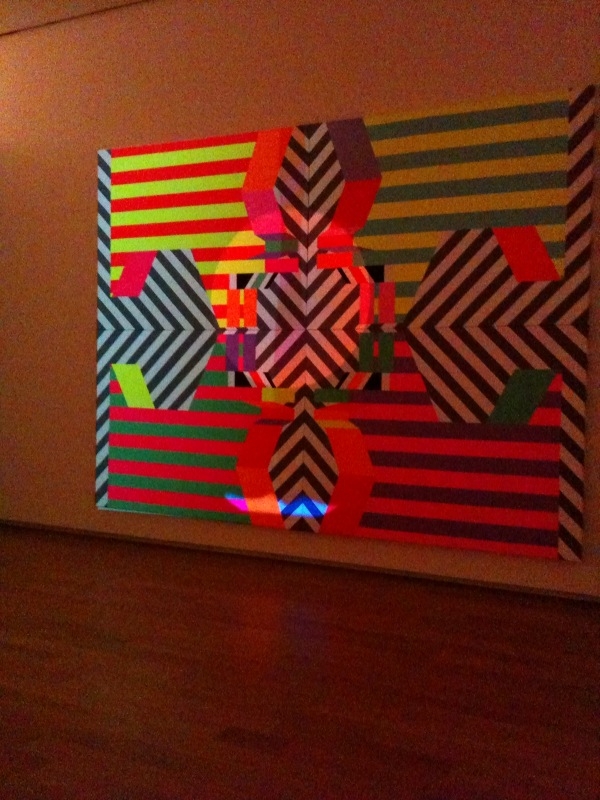
Now, most museum collections are not for touching. (Although within the last several years, the visually disabled have challenged these restrictions to allow a multi-sensory experience.) Some artwork relies on the viewer’s participation, as with the growing phenomenon of interactive art. Yet, with this particular piece, if one were to block the light from the projector, whether intentionally or accidentally, one would be changing the composition, altering the entire piece. While the viewer is not physically contacting the painting, is he/she still considered to be touching the art? Where are the boundaries in such work?

I really want to see this and will definitely include a stop by the modern next time I’m in DFW. Not sure what I think regarding your question. I guess my first response is to not think of it so much as “touching” the art, or crossing any boundaries, but as more becoming part of the work and activating the space. Once again, I really want to see the piece and installation to fully understand Jones’ set up. It makes me think of a work I saw at the Menil here in Houston not long ago, a video installation in one of the contemporary galleries. I can’t recall the artist, but basically there was a video projector set up in the middle of the gallery. Everyone kept looking around trying to figure out where the image was being projected or basically what was going on. Then a guard pointed out that you have to stand in this one corner, then the image is projected onto you, in this case it was text I think. So basically, the work of art is not even visible without human interaction, human touching. Just an interesting comparison to your comments regarding touching, boundaries, etc with Jones’ work. And I’m curious regarding your use of the term “boundaries” in your post. Do you mean this in reference to the “don’t touch art” aspect of museums, or in reference to who / what is the art work and who has control in changing / altering the final product?
The piece you encountered sounds like interactive art, whereas Jones’ piece does not intend for viewer interaction.
When I question the boundaries in this artwork, what I’m refering to are the boundaries in terms of physical touching vs. virtual(?) touching. A viewer can stand under the projector, lift up their hand and block the light composition, leaving just the physically painted composition. But then the entire piece has changed. The projected light design is part of the artwork. This is definitely a question of “touching” of some sort. I do not feel that the artist intended for the viewer to play with the projection. It works on its own.
Hopefully I can post images soon to provide a better picture of the issue.
Yeah, I really want to see images. Need to get up there to see it. So by the installation it appears that Jones did not intend for the viewer to alter the projection? I assume this particular piece is what he refers to as his light paintings? It’s interesting to consider the artist’s background in animation as well, considering that animation involves the combination of a hand-made image with video / light projection.