Les Promesses du Passé
by Kelly Presutti | 21 April 2010 | Books, Contemporary, Museums
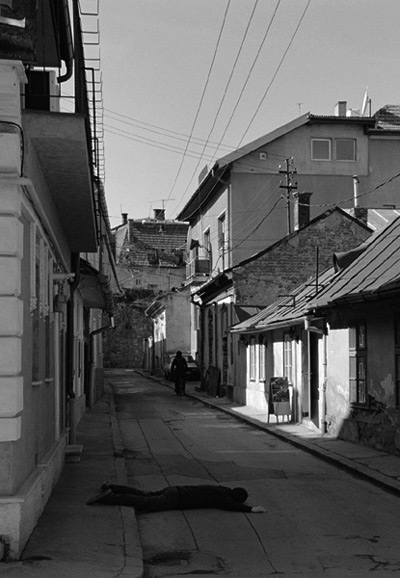
Ciprian Muresan, Leap into the void - after three seconds, 2004
Prompted by the opening of Les Promesses du Passé at the Centre Pompidou, some recent work on post-Wall “Eastern European” art (one of the tenets of the exhibition is to demonstrate the irrelevance of this term in light of the polyphony of voices; the exhibition layout is designed to be discontinuous, accordingly):
Transitland is a “collaborative archiving project” with 100 single-channel video works produced between 1989 and 2009 in Central and Eastern Europe. A related publication is also available.
The papers collected in Mel Jordan and Malcom Miles’ Art and Theory After Socialism, written by politically engaged artists, critics and curators, provide both theoretical and practical accounts of recent and contemporary art from Armenia, Germany and the United Kingdom. Miles writes in the introduction:
For want of a better term, the condition of post-socialism… indicates European culture after the demise of state socialist regimes in the East bloc while, I would argue, socialism as an ideology is not erased by the failure of state socialist regimes. The book offers a series of specific windows on this field.
In Victor Tupitsyn’s The Museological Unconscious he defines a “communal optic” as requisite lens for viewing Russian contemporary art:
Tupitsyn argues that socialist realism does not work without communal perception—which, as he notes, does not easily fit into crates when paintings travel out of Russia for exhibition in Kassel or New York. Russia, he writes, went through an immense “optical restructuring” in the 1930s, in which viewers of art were “communalized.” … Russian artists, critics, and art historians, having lived for decades in a society that ignored or suppressed avant-garde art, have compensated, Tupitsyn claims, by developing a “museological unconscious”—the “museification” of the inner world and the collective psyche.
Art Power, by Boris Groys, argues for “for the inclusion of politically motivated art in contemporary art discourse” noting that art
is produced and brought before the public in two ways—as a commodity and as a tool of political propaganda. In the contemporary art scene, very little attention is paid to the latter function; the official and unofficial art of the former Soviet Union and other former Socialist states, for example, is largely excluded from the field of institutionally recognized art, usually on moral grounds (although, Groys points out, criticism of the morality of the market never leads to calls for a similar exclusion of art produced under market conditions).
For more, see Art Margins, which offers book reviews, articles, artwork and interviews focused on Central and Eastern Europe.
