What’s Eating CAA?
by Jon Lackman | 22 October 2010 | Conferences, News
“A man stood up from the audience and said, ‘I’m Mary Jane Jacob and I’d like permission to speak.’ ” The audience at this conference session had just been introduced to the session’s panelists and informed that one scheduled participant, the curator Mary Jane Jacob, wouldn’t be able to make it. So who then was this man pretending to be her? The setting was last February’s College Art Association conference in Chicago. With the panelists’ permission, the man proceeded to give a full-length talk, complete with slides. By all accounts, it was rather boring, prompting little comment. Indeed the whole performance probably would have disappeared without a trace, had not the College Art Association found about it and posted this addendum to their online conference archives:
At the session “Studio Practice and Poststudio Production: Reconsidering the Roles of Artist and Curator” … the session chair Michelle White allowed an imposter to present himself as CAA member Mary Jane Jacob. The presentation was not authorized by either CAA or Prof. Jacob and did not represent her views. Neither the impersonation of individuals nor the misrepresentation of their views at a CAA forum is consistent with the ethical standards of CAA or the visual arts profession that we represent.
CAA also issued this more strongly worded statement to session chairs for the upcoming February 2011 conference in New York:
At a recent CAA conference, a session participant assumed the identity of a living scholar and made a presentation in that guise. This impersonation was part of a performance event that was not made known to CAA or the person whose identity was stolen. This dishonest action in the guise of art was deeply troubling and embarrassing for the victim and CAA.
I am writing to ask you to verify that the information presented to you by speakers is original, that the participants in your session are who they claim to be, and that your session is not a performance, unless it has been presented as such in your application to the program committee.
What happened?
It’s not clear from these statements what exactly transpired, nor why the event so bothered CAA. It doesn’t reveal the impersonator’s name; it’s unclear if CAA even knows it. If it does know, is he now banned from CAA conferences? (I don’t know his name – anyone recognize him from the unfortunately rather dark photograph below?) There’s no audiotape of the session available on CAA’s website, though nearly all sessions are recorded, unless a panelist objects. When I asked CAA to discuss the matter, executive director Linda Downs wrote, “CAA has no comment on the session.” Session chair Michelle White, a curator at the Menil Collection, also declined to comment.
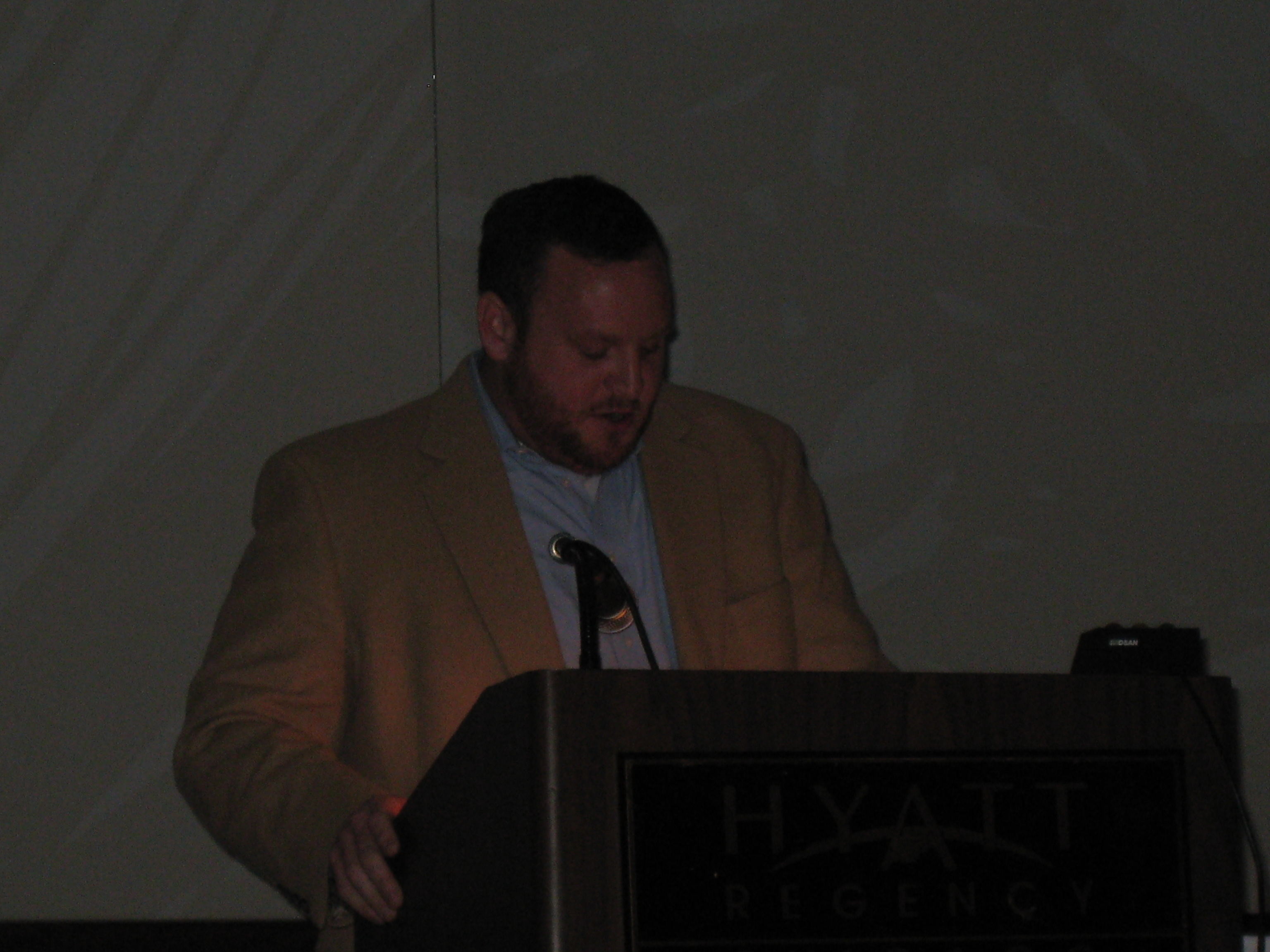
I tried contacting all the session’s panelists and Jacob. I finally succeeded in speaking with two panelists, on condition of anonymity. They struggled to recall the eight-month-old events, but both thought they could remember White telling them, after the session was over, that the man belonged to Jackson Pollock Bar, an artist collective known for similar performances. (The genre seems to have been pioneered by Robert Morris; in a 1964 performance, he lip-synched a lecture that Erwin Panofsky had once recorded.) However, one panelist asked how that could be, pointing out that one of the impersonator’s slides had said, “Inspired by Jackson Pollock Bar.” When I contacted the group, they denied involvement: “No, we didn’t participate in the College Art Association session with White and Wilder, unfortunately not.”
What was Michelle White’s involvement exactly? Did she just let the impersonation happen? Was she in on it? Did she herself orchestrate it? CAA’s statement is ambiguous, as are the reports I got from panelists. Both agreed that during the session, White acted as if it were all a surprise to her. One panelist said that after the session White admitted involvement; the other couldn’t remember this. The latter said that before the session started, “Michelle told us there was this mix-up, that they had accepted this paper they thought was by Mary Jane Jacob, then CAA had told them Jacob was already on another panel and wasn’t eligible to present two papers at the conference. Mary Jane Jacob was notified of this and she said she didn’t submit a paper to our panel.” However, as far as I can tell, Jacob’s only other involvement with the 2010 conference was to receive an award from the Women’s Caucus for Art.
CAA’s online statement implies that the session had only one chair, Michelle White (“the session chair”). In fact, it was co-chaired by artist Hilary Wilder. What was her involvement, if any? (She hasn’t responded to my requests for comment.) The fact that CAA didn’t censure her seems to imply that her involvement was minimal. This also implies that White was in on the impersonation – for, if all White did was let an unknown figure come up on stage, then what separates her from Wilder?
Mary Jane Jacob responded to me with a short email, “It was something like this panel below (see “Alfred Barr”), only not so clearly indicated and, for CAA, outside their protocol,” to which she attached the following. The panel she refers to appears to have included someone pretending to be the famous (and long dead) MoMA director. Jacob’s email seemed to me to leave open the possibility that she had been in on the performance, despite CAA’s statement to the contrary. A follow-up query to Jacob has so far gone unanswered. One panelist said to me, “Jacob must have been involved – he [the impersonator] had all her slides.”
Why Condemn It?
CAA’s response to the affair is interesting, irrespective of the impersonator’s identity and who knew what when. When I first learned of its statements, they frankly seemed to me like part of the joke. “I am writing to ask you to verify that … your session is not a performance, unless it has been presented as such in your application to the program committee.” Aren’t all panels performances?
When I realized CAA was acting in earnest, its statements seemed to beg ever more questions. For one: Does an audience really need to be told that “Mary Jane Jacob” is not a man? We live in an age of transvestitism and gender change, but still. Also: If he really was Jacob, why would he be seated in the audience and ask permission to speak? Perhaps CAA feared that the audience had been fooled by the very absurdity of the impersonation. (As George Pendle noted in a recent Modern Painters article about artistic imposters, “the more you look like your subject, the less convincing you will be. In 1915, when Charlie Chaplin entered a Charlie Chaplin look-alike contest in San Francisco, he failed even to make the finals.”)
The thing I really couldn’t figure out was why CAA would treat as “deeply troubling and embarrassing” what seems to have been a rather humdrum, if not positively trite bit of performance art. CAA seems to be worried that this episode will spark a rash of speaker impersonations, but the event would’ve been forgotten if CAA hadn’t called attention to it. In that sense, you could say CAA participated in bringing the performance to its full fruition. (Of course, by writing about it I’m also complicit.)
Both my sources said that the impersonator’s lecture was off-topic, inoffensive, and essentially forgettable. According to one, “It was rambling and incoherent. It ran through a gamut of things that he wanted to talk about – the Copernican Revolution, the NEA, right-wing politics.” According to the other, “He gave a talk Mary Jane Jacob had given before, I think. It wasn’t really about what was being discussed. It was more like a professional talk, like ‘This is who I am, this is what I’ve worked on.’ At one point he said, ‘You think I’m pretending to be Mary Jane Jacob but really I am Mary Jane Jacob.’ That part was bizarre. But then he ended. It was anticlimactic. He really just gave a regular talk.”
Another person who attended the talk gave me some snapshots of his slides. They show a work by Gordon Matta-Clark (the subject of a book by Mary Jane Jacob); photographs of Richard Serra, Leo Castelli, and Knight Landesman; phone numbers for Michigan congressman Bart Stupak; and a map of Stupak’s district. According to one panelist, at one point the impersonator urged people to call Stupak to encourage him to back health care reform.
The talk was so dull that the audience paid it little mind. (One posed a question to the impersonator during the question-and-answer period, but he deflected, saying that time would be better spent sticking to the topic of the panel.) One panelist said to me, “It was a non-event in the end. Oddly, someone was there from Artforum.com, but she didn’t put it in her report. In that sense too the performance failed. You couldn’t ask for more exposure than that website, and he didn’t get it, even though the reporter was there … If the tree falls in the woods and no hears it, did it happen?” This panelist blamed the impersonator’s failure on his failure to truly engage the panel’s topic (“Studio Practice and Poststudio Production: Reconsidering the Roles of Artist and Curator”) but acknowledged, “It was sort of related. It was blurring the boundaries between artists and curators. Michelle was acting like an artist, or Mary Jane Jacob was acting like an artist.” (That is, if Jacob was in on it.)
Perhaps Jacob’s impersonator was boring intentionally, to satirize how dull academic panels often are. Innumerable panelists at CAA and elsewhere read droning, canned, self-promoting press releases that barely relate to their session topic, and run too long, eroding the time set aside for discussion. There is then little to no “exchange,” and no real need for the panelists themselves to even be present – a point neatly made by this impersonator. As his co-panelist put it, “He really just gave a regular talk.” (Wouldn’t CAA be improved, I wonder, if panelists simply posted their papers online for people to read beforehand? Then the sessions themselves could be devoted to pure discussion.)
I don’t mean to tar CAA’s conferences or the broader organization, both of which have improved in recent years. (Think of caa.reviews, for example.) After all, CAA can hardly be expected to be much more open-minded than the field itself, which is of course still conservative in many ways.
That said, CAA’s response still baffles me. Does it truly fear its credibility is endangered by this impersonation? Was anyone actually offended by it? (Neither panelist I talked with found it at all objectionable.) Does it think this kind of response is effective? Does it think it can invite thousands of artists and critical thinkers to gather every year, and expect them never to talk out of school, never to tweak the institution’s authority and pretensions? When asked why he impersonated the artist Maurizio Cattelan for several years (with the artist’s cooperation), curator Massimiliano Gioni replied, “For all its pretense of being avant-garde, the art world still believes in authorship and sincerity, and that seemed so artificial to us.” Another irony of CAA’s censure is that it comes as CAA itself is trying to spice up its conferences, with panels of experimental format, for example. Play is good, CAA wants to say, but only as long as it’s in on the joke.

Your questions about CAA’s motives are good ones, but it seems clear to me why they would denounce this act. It is both deliberately deceptive and, as those present seem to attest, a waste of everyone’s time. It thereby undermines CAA’s implicit claims that the conference is a professional, scholarly, and worthwhile activity. What if this person had published a paper under another author’s name without that author’s permission under the guise of “performance art”? In principle it would be quite similar. And what of the audience members who take this person at their word, and then go on to spread all sorts of misinformation about Jacob and her work, not to mention the nature of CAA? It would difficult to convince my institution that spending money to send me to an event of this nature is an investment in its future.
As for Gioni’s comment, Western culture clearly still believes very much in authorship, though the nature of the construct may have shifted. I’ll line up every time David Fincher makes a film. Art is not necessarily avant-garde, nor should it have to be. Regarding sincerity, the day I stop believing in and looking for it you can put me in my grave. A perceived lack of sincerity is the first sign to me that an artwork is wasting my time.