Cosmopolitan Lucknow
by Kelly Presutti | 15 December 2010 | Books, Museums
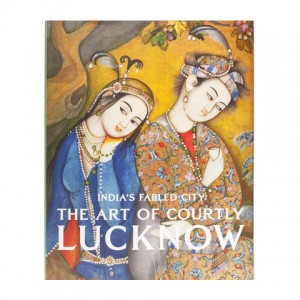
India's Fabled City: The Art of Courtly Lucknow
A current exhibition at LACMA is challenging the notion of “hybridity” in the Indian city of Lucknow. Lucknow was a courtly city of great wealth between the declining Mughal power and the rising British Colonial one. At its height in the mid-nineteenth century, two-thirds of its population were artisans, leaving a vast cultural legacy. Commonly understood as a site of exchange between European and indigenous traditions, the show and its catalogue seek to reassess the cultural forces at work and present a more complex cosmopolitanism, including the distinct ways the city’s identity was filtered through the British and Indian lenses. While the show addresses the cultural cross-dressing of Europeans who wore Indian garments in private and the Nawabi interest in European artworks, the interaction with Europe is only a limited part of the story. Exchange with Delhi and Iran was equally important, and examining these influences combats assumptions that classify Lucknow’s splendor as “provincial Mughal” or “Company style”. While an 1856 uprising solidified the perception of Lucknow in the minds of the British, a city of past glory, the “Paris of the East”, the exhibition demonstrates how cultural production continued and the city constantly evolved.
The catalogue was edited by Stephen Markel with Tushara Bindu Gude, and “this first book to fully explore the opulent art and refined lifestyle of Lucknow showcases cultural diversity at its most magnificent.” The publication includes essays by Muzaffar Alam and Sanjay Subrahmanyam, Catherine Asher, Rosemary Crill, Sophie Gordon, Rosie Llewellyn-Jones, Peter Manuel, Carla Petievich and Malini Roy.
For further reading, Natasha Eaton’s essay “Critical Cosmopolitanism” in Art and the British Empire examines practices of gifting and collecting in late eighteenth century Lucknow and “explores the disjuncture between Lucknawi and colonial ideas of cosmopolitanism by comparing the Awadhi combination of Shi’ite kingship and the Mughal ethos of the Padshah – ‘the King of the World’ – with European ideas of cosmopolitanism as an enactment of citizenship in the world.” She also cites Ziauddin Sardar’s description of the city, which characterizes Lucknow as a site with a layered and nuanced identity: “an intersection point of many timelines, many different trajectories… its histories refer to and connect with different periodizations, look to other centres, not only the western metropolitan ones… Its cosmopolitanism is the kind of cosmopolitanism unimaginable in cities of the west that, reluctantly, belatedly and half heartedly embrace the rhetoric of multiculturalism.”
