‘American art collectors ripe for study’
by Jon Lackman | 19 July 2010 | Uncategorized
More on the history of American collectors from the L.A. Times:
With names like Morgan, Getty and Huntington attached to impressive collections available for public view, the history of art collecting in America has acquired a new level of scholarly scrutiny … Art historians tend to concentrate on connoisseurship and aesthetics. That’s beginning to change. Thanks to expanding views of art history, a fresh crop of scholars intrigued with the socioeconomic context of collecting and the provenance of art objects are giving American collectors a new level of scrutiny and respect. “The history of collecting is so deliciously interdisciplinary,” says Inge Reist, who directs the fledgling Center for the History of Collecting in America at the Frick Collection in New York … So far, the archives directory encompasses about 5,000 collections in 500 repositories documenting the lives and activities of 1,500 American collectors … The Getty Research Institute, established in 1982, has a much broader reach than the Frick center, but its special collections contain an expanding trove of letters, business records and libraries of American collectors, dealers, artists and critics. The enormous archive of Joseph Duveen, the dealer known for selling the collections of impoverished Europeans to fabulously wealthy Americans, including Frick, Huntington and Mellon, is in great demand, says Marcia Reed, chief curator and head of collection development at the Getty’s research library.
Why all the interest in the history of collecting? Is it related to the prominence of contemporary collectors? Some would even say preeminence. In the opinion of individuals such as collector Adam Lindemann, “declining budgets mean that the world’s leading museums, once the bastions of art, can no longer compete with deep-pocketed collectors.”
In the papers
by Ben Lima | 18 July 2010 | Uncategorized
Recently in the press:
- The Education of the Virgin (c. 1617), in the collection of the Yale University Art Gallery, has been reattributed by curator John Marciari to Velázquez. See Marciari’s article in Ars Magazine (full text not online); The Guardian; Los Angeles Times; El Pais.
- “Fra Angelico to Leonardo: Italian Renaissance Drawings” at the British Museum, reviewed by James Hall in the TLS
- On Leonardo’s Virgin of the Rocks: Jonathan Jones in the Guardian
- On connoisseurship and the controversial “forensic art expert” Peter Paul Biro: David Grann in the New Yorker (16000 words)
- Also on connoisseurship and attribution: “Close Examination: Fakes, Mistakes and Discoveries,” an exhibition at the National Gallery (London) reviewed by the Economist and by Peter Campbell in the LRB
- Photography: book reviews of Henri Cartier-Bresson, Bernd and Hilla Becher, Wolfgang Tillmans, and Andy Grundberg’s essay collection Crisis of the Real: Jackie Wullschlager in the Finanical Times
- On Andrew Graham-Dixon, Caravaggio: A Life Sacred and Profane, in the Economist
- Kevin Starr, Golden Gate: The Life and Times of America’s Greatest Bridge, reviewed by Herbert Gold in the WSJ
Collection as Emancipation
by Jon Lackman | 16 July 2010 | Books
Also in caa.reviews recently, Laura R. Prieto reviewed Dianne Sachko Macleod’s Enchanted Lives, Enchanted Objects: American Women Collectors and the Making of Culture, 1800–1940:
It is an open secret that many museums, large and small, owe the strength of their collections to women patrons, yet few scholars to date have studied women as serious art collectors and tastemakers … Macleod traces the arc of women’s involvement in collecting. What originated as a solitary pursuit in the early nineteenth century blossomed into a Gilded Age social performance. It then transformed gender expectations at the turn of the twentieth century … In Macleod’s conception, collecting art was a sort of consumption that led to psychological and emotional empowerment … Whereas market-driven mass consumption might co-opt women’s desires, the purchase and control of art objects ultimately gave women access to “the male discourse of possessive individualism” (45). Some then projected their emancipation outward to the built environment, the staging of world’s fairs, suffrage advocacy, and philanthropy … [Macleod's] interdisciplinary approach ultimately relies most on psychoanalytic theory, especially the concept of transitional objects and the well-established psychological significance of play. Macleod argues persuasively that collecting could be imaginative, creative play, from a manifestation of desire to an act of reverie … An underdeveloped aspect of the study is the role of class and race in collecting … Enchanted Lives, Enchanted Objects will captivate scholars in many fields, from material culture and American studies to women’s and gender studies. This is not only a book whose physical beauty will grace the shelves; Macleod raises fascinating questions about the connection between art and subjectivity.
A ‘Colossal’ Text
by Jon Lackman | 16 July 2010 | Ancient, Architecture, Books
In caa.reviews, Thomas J. Morton considers a new book by Katherine E. Welch:
The Colosseum, more than any other building from ancient Rome, is routinely the subject of both scholarly and popular texts. While it seems that important studies are published on this structure every year, rarely does any attain the status of definitive text. Katherine Welch’s The Roman Amphitheatre: From Its Origins to the Colosseum is such a book. Welch’s splendid volume is a culmination of her amphitheatre studies and provides a much-needed examination of the building type’s origins in Republican Rome and its development up to and including the Colosseum.
FRENCH COMICS: “NOT JUST FOR CHILDREN”
by Karen Leader | 15 July 2010 | Books
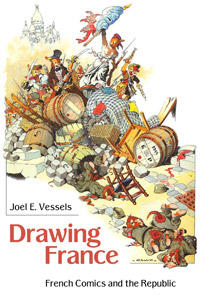
[A review of Joel E. Vessels, Drawing France: French Comics and the Republic (Jackson: University Press of Mississippi, 2010)]
This is an ambitious attempt to weave a thread that connects French politics, cultural policy, and nationalism, from the “golden age of caricature” through the “golden age of BD [bande desinée].” Stops along the way include a clarifying section on Philipon and l’affaire de la poire that forever enshrined Louis-Philippe in pyriform; the nauseating muck through which some anti-Semitic illustrators slogged during the Dreyfus affair; and the superior and influential satire of L’Assiette au Beurre. Starting with Philipon is strategic, because it was then that the demand for special scrutiny of images, which “strike the sight” and stir up passions “without reasoning,” was hatched in the chambers of state power. Despite its seductive full-color cover, an anthropomorphized recreation of Delacroix’s Liberty Leading the People by the artist Calvo, Vessels’ book contains few illustrations and little discussion of the technique, style, or aesthetics of French graphic humor. This is not a criticism, just a warning.
Having established a nineteenth-century foundation, Vessels then narrows the focus onto la presse enfantine, the true birthplace of modern day BD. Concern over the well-being of les enfants pits Communists against Catholics, entrepreneurs against anti-Americanism, Tarzan against “true France,” Vichy against, well, everything, and, censorship against republican values, seemingly in perpetuity. Somewhere along the way, BDs become “not just for children anymore” and if I have one gripe it is that the author could have dealt more critically with the ramifications of this development.
Vessels, channeling the dictum of historian Richard Kuisel that “the evidence must always speak for itself,” (ix) offers an exhaustive history of the bureaucratic maneuvers, propaganda battles and continual re-definitions of cultural patrimony that would define, restrain or promote BDs as authentically French. Visit the festival for bédéphiles in Angoulême, or survey the prices garnered for Tintin memorabilia, and you will think the story is settled. I wouldn’t count on it. Incidentally, if this is an area of interest, I recommend the site Caricatures et Caricature.
‘Artefakt’
by Jon Lackman | 15 July 2010 | Journals
If you read German, I recommend the young online magazine Artefakt, published by beginning and advanced students (and alumni) of the Institute of European Art History at the University of Heidelberg. In recent issues, contributors interviewed a Frankfurter Allgemeine Zeitung editor about the state of art criticism, artist Derek Ogbourne about his work, and an art librarian about the changing landscape of print and online publishing. Another article reviewed several of the new online and open-access scholarly art-history journals to have appeared recently.
‘It’s no big deal’
by Jeremy Miller | 14 July 2010 | Teaching
A recent NYT editorial by Brent Staples about the ease of plagiarism in the internet era is one of many recent articles regarding technology and education. The casual attitude portayed in the article is one I encounter regularly, and I wonder if the research paper still retains much value as an educational tool or assessment technique for undergraduate students? I am curious about others’ experiences and approaches in teaching undergraduate art history, as I refuse to go into “police” mode.
8 Comments
‘What is Architectural History?’
by Jon Lackman | 13 July 2010 | Architecture, Books, Theory
In his new book What is Architectural History? Andrew Leach surveys the history and current state of the discipline. His book is written for students and professionals, and assumes a certain familiarity with architecture. There is considerable new material for him to synthesize — architectural history and historiography have both been expanding. He argues that numerous excellent works of historiography have been produced in recent years, although these are almost always focused on individual architectural historians, a national tradition, or a narrow epoch, and so provide little help for the scholar seeking an overview. He notes also that the discipline is hard to define, having been written by both architects and historians, for a diverse array of audiences. It feels to him like a still young and unformed discipline that really only came of age institutionally in 1975, when MIT first offered a PhD in the history, theory, and criticism of architecture (though UPenn and UC-Berkeley had started programs earlier): “Under the guidance of Standford Anderson and Henry A. Millon, architecture faculty and students alike sought to intellectualize architecture and its history on terms that ensured the full participation of architecture in the wider development of the critical humanities.” Surveying the current scene, he finds an emphasis on postcolonialism and, unsurprisingly, a certain dissatisfaction with “theory” and a concomitant call for a “return to history,” however problematic.
1 Comment
-
Jeremy Miller said on 14 Jul 2010 at 7:08 am:
For what it’s worth, I sometimes teach an introductory survey of architecture course, and I find the relative lack of development in the history of architecture liberating. It has its problems for sure, but it forces me as an instructor to to be more analytical and creative in constructing my course content.
Duchamp the Anti-Scientist
by Jon Lackman | 12 July 2010 | Books, Modern
The book Duchamp and the Aesthetics of Chance: Art as Experiment, an investigation of the artist’s 3 Standard Stoppages (1913-14), by Herbert Molderings, had already appeared in German and French, and is now available in English too. The book attempts to overturn the popular of image of Duchamp as an “artist-engineer-scientist,” arguing instead that he “subverted scientism in favor of a radical individualistic aesthetic and experimental vision.” Scholar Lars Blunck reviewed the book very favorably in 2006 (“dieser wunderbaren Studie”). On a related note, it seems worth noting that various recent exhibitions have addressed modern artists’ interest in chance, for example last year’s “Chance Aesthetics” at Mildred Lane Kemper Art Museum.
Museum of Strife
by Jon Lackman | 8 July 2010 | Architecture, Contemporary, Museums
The Winter 2010 issue of Critical Inquiry is gripping, and I’m surprised it hasn’t gotten more attention. Editor W.J.T. Mitchell gives the background in his introduction:
In the spring of 2009, Critical Inquiry received an article from [UCLA English and comparative literature professor] Saree Makdisi critiquing the Simon Wiesenthal Foundation’s proposed Museum of Tolerance in Jerusalem. Designed by Frank Gehry, the proposed museum has been the subject of controversy since it was first proposed. The chosen site was on one of the oldest Arab cemeteries in the Middle East … [We] accepted the article for publication with the idea of soliciting responses that would fairly represent the major positions on the issues. We began by inviting Frank Gehry himself to respond, which he agreed to do. At the same time, however, he requested that Critical Inquiry provide space for a response from a team of Israeli scholars that Gehry regarded as more conversant with the complex legal issues … [We also invited responses from] Jeremy Gilbert-Rolfe, who has written extensively on Gehry, [and from] Daniel Monk, an Israeli architect and the head of Peace and Conflict Studies at Colgate University … The whole dossier is gathered here [together with Makdisi's response to the responses] … We should mention one event that occurred in the early fall of 2009, just as this dossier was nearing completion. Frank Gehry announced his decision to withdraw from the [museum] project, but not, he hastened to assure us, because of Makdisi’s essay.
In his essay, Gehry states, “Although the court-imposed delays have now passed, for scheduling reasons I have withdrawn from the project and am no longer involved with it or the project owner, the Simon Wiesenthal Center.”
It seems impossible for me to summarize or quote from the issue’s many lengthy essays in a fair and representative fashion. That said, here first is a portion of Makdisi’s:
… The redefinition of tolerance as an exclusive claim and the usurpation of universality enacted by the Museum of Tolerance must be read in this context as well – as a profoundly ironic gesture, though one for which the irony must be seen as unavailable to the project’s backers, even when it is stated as baldly as in The Independent’s headline reporting the story, “Israel Plans to Build ‘Museum of Tolerance’ on Muslim Graves.” (Or for that matter when it is considered in terms of the fact that this museum so unrelentingly hostile to the other in the name of tolerance is being designed by an architect who has only recently publicly embraced his Jewishness but who, in an age of actual intolerance in America in the 1950s had felt compelled to change his name from Goldberg to Gehry and to suppress his Jewish identity in order better to fit in with a mainstream from which he felt he might be excluded as other) …
What is at work here, then, is not a first-order kind of denial and erasure, but rather a second-order kind. This form of Zionist subjectivity is premised on the act of denying that there has been a denial, erasing the fact that an erasure has taken place. Rather than denying the rights of the Palestinians, it denies that their rights have been denied …
This second-order denial is exactly what the Museum of Tolerance in Jerusalem is all about … And it is perfectly fitting, then, not simply that such a museum should be built on top of an ethnically cleansed graveyard but that those who will eventually gather to celebrate its opening – and those who will visit it in the years afterwards—will have no idea of the profundity of the historical, material, and psychical layers of denial on which they stand.
And here is some more of Gehry’s essay:
When I was eight years old I lived in a town in northern Ontario – Timmins – and there were only thirty Jewish families. It was a mining town of thirty thousand people. My family name is Goldberg. I was the only Jew at the elementary school I attended. I was beaten up regularly on the way home from school for killing Christ. This went on for a couple of years; I would come home bloody. There were unfair numbers against me. At some point I gathered up the strength to fight back and prevail … At the end, the last year I was in Timmins, I became friends with my enemies. So this experience ingrained in me a model of how to deal with anti-Semitism at a very young age …
Now many years later I have outgrown any religious involvement. I am married to a Catholic. My sons have been baptized, and I’m generally liberal about what people believe in and don’t have a need for formal religious involvement. Of course, there are residual cultural gratifications like bagels and lox and matzo ball soup. My name was changed to Gehry to please my former wife, who was pregnant and worried about bringing a child into a world that showed its anti-Semitism even in my college days at the University of Southern California in the early 1950s …
Why would I read in a so-called scholarly treatise on the Israeli-Palestinian issue a critical word about my hiding my Jewishness by changing my name? The Hitler period proved that it did not matter whether you were religious or had a Jewish name; as long as you were considered Jewish even marginally you were put in the ovens … [Makdisi] further undermines his credibility by choosing to enter the field of architectural criticism — a field in which he is obviously illiterate. He discusses the symbolism of walls from model pictures when he does not have any clue what they really are and how they look in real time and at real scale.
‘Beyond the Aesthetic and the Anti-Aesthetic’
by Jon Lackman | 7 July 2010 | Conferences, Theory
The theme for this year’s Stone Summer Theory Institute is “Beyond the Aesthetic and the Anti-Aesthetic”:
This year’s event addresses one of the central puzzles of contemporary art practice: the choice between continuations of modernism (with its aesthetic values) and the many kinds of postmodernism (which privilege politics, gender, identity, and many issues outside of aesthetics).
To be held July 18-24, the event has been co-organized by Diarmuid Costello and James Elkins. The opening and closing roundtable discussions will be open to the public, as will lectures by the organizers, Hal Foster, and Eve Meltzer. Other participants will include Jay Bernstein, Michael Kelly, Joaquín Barriendos, and Joana Cunha Leal.
Leo Bersani and ‘The Aesthetics of Existence’
by Jon Lackman | 6 July 2010 | Theory
In an article titled “Sex and the Aesthetics of Existence” in the March 2010 PMLA, Tim Dean writes:
Leo Bersani’s contributions to queer theory have been essentially traumatic. Ever since “Is the Rectum a Grave?” with its startling opening sentence (“There is a big secret about sex: most people don’t like it”) Bersani’s writing on sexuality has disrupted the conceptual coordinates of queer theory, a field that officially welcomes the disruptive. What has made Bersani hard to assimilate is less his psychoanalytic emphasis on the ineluctable masochism of sexuality (a principal reason for the aversion to sex) than his insistent conceptualization of sexuality in aesthetic terms … [H]is earlier work claimed that art has effects on the human subject akin to those of sexuality, while his later writing proposes a specifically aesthetic subjectivity—rather than the sexual kind—as the preferred basis for relating to the world beyond the self.
(By the way, Leo Bersani is the keynote speaker at a University of Chicago graduate conference this October 21-22. He was the subject of a three-day seminar in 2009.)
The Glorious 18th Century
by Jon Lackman | 5 July 2010 | Baroque/Neoclassical, Books
There’s nothing like a holiday weekend for catching up on unread issues of The New York Review of Books. I belatedly discovered Willibald Sauerländer writing in April 8 issue: “the full richness of eighteenth-century French sculpture—as spirited as it was virtuoso—has been little noted outside its homeland.”
And Ingrid Rowland in the March 11 issue, who argues for the art of eighteenth-century Venice, which she suggests is superior to that of Venice’s “arrogant heyday.” On the subject, she recommends the recently published “Tiepolo Pink,” by Roberto Calasso, “in which history and erudition lend their piquant spice to the sheer pleasure of being alive.”
(Back in April, Ben Lima rounded up Tiepolo Pink reviews.)
From Acting to Art History
by Jon Lackman | 1 July 2010 | Uncategorized
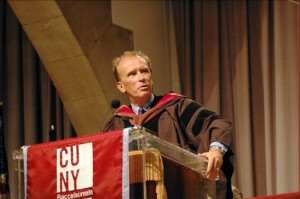
The 63-year-old actor Peter Weller, known best as RoboCop, recently completed Syracuse University’s MA program in Renaissance art (two-thirds of which is conducted in Italy) and he is now at work on a PhD at UCLA. He recently discussed his life in a commencement address at the City University of New York:
I was inspired to return to grad school by … Dr. Maria Conelli, present director of the American Museum of Folk Art … In the midst of my master’s degree in Florence, when they informed my that I had to audit extra classes and, thus, back-pack my way at 7 a.m., with hundreds of adolescents, through the throngs of jaded tourists and mosquitoes, two miles to school every morning, and then spend the afternoon reading medieval Italian with other cranky grad students in moldy archives, I considered putting out a contract on Maria Conelli … However, both my late mother, Dorothy, and my wife, Sheri said 1) “You don’t quit” and 2) “A little humility is good for you.” … As recently as a month ago, I thought, “why the hell am I doing this?” during a PhD written exam on Roman Triumphal arches. Four hours in a locked room pounding out words on monuments most of the world has never seen and never will … I stood on the Ponte Vecchio and yelled into the river Arno, as well as whatever river gods would hear me, “why in hell am I doing this?!!” My mother immediately barked back at me, “Why NOT?… what else you got to do?”
By the way, two of my three personal recommendations to Syracuse were written by Woody Allen and Gore Vidal. Woody handwrote, in Venice, on Hotel Gritti Palace stationery, “Peter Weller is my friend, a fellow actor, writer, director, musician and a credit to his race.” As if I was a good “white guy.” Gore Vidal was less oblique: Vidal, typing on a an old Remington wrote, “ I’ve known Weller a long time. He is an extraordinary student… of exactly WHAT… I have no idea.” However, my third recommendation was written by the ex-mayor Richard Riordan of Los Angeles. Mayor Riordan was the first to point out to me that education is the ONLY portal to the road of solution regarding the police stations, hospitals and death that await our youth if they feel the only alternative is “the street” … [But as] the great grand-daddy of all educators, John Dewey said, “education is not the preparation for life; Education IS life.” … I conclude with George Bernard Shaw who said a good life is nothing but a series of INSPIRED follies; the problem, however, is to find them to do.
3 Comments
-
Stephanie Stambaugh said on 8 Jul 2010 at 3:48 am:
It is wonderful to hear of Weller’s journey and the women who have inspired him to follow his passion. We could all take a lesson from his dedication to art and step out of our comfortable surroundings and dig a little deeper into our own dreams and see them through to the end. Thank you for sharing this.
-
Lee said on 8 Jul 2010 at 11:08 pm:
I think the Shaw quote should be a “series” of inspired follies, not a “serious.”
But otherwise, thanks!! -
Jon Lackman said on 9 Jul 2010 at 6:01 am:
Thanks, fixed it.
Reform in a global context
by Ben Lima | 1 July 2010 | Conferences, Islamic, Pre-Columbian, Renaissance
On July 9th, the Institut national d’histoire de l’art in Paris will present “1500-1600. Entre Islam et Nouveaux Mondes: les réformes dans un contexte global,” in the Salle Walter Benjamin of the Galerie Colbert. The event aims to extend the Reformation’s questions of “idolatry” beyond the European context, and consider well-known Reformation images within a broader frame of reference. Participants will include Barry F. Flood, Alexander Nagel and Alessandra Russo. The website includes capsule biographies and lengthy suggestions bibliographiques from each participant [22-page PDF]. The event is organized by the research group “1500-1600. Rome, Wittemberg, Constantinople, Jérusalem, Mexico:
La Réforme dans un contexte global.”
1 Comment
-
Ben said on 1 Jul 2010 at 7:50 pm:
Publishing suggestions bibliographiques in advance: is this a French custom? I think it is an excellent idea that more conferences should adopt, as it could possibly lead to better-informed audiences.
Obit: Daniele Di Castro
by Jon Lackman | 1 July 2010 | Museums
According to the Jewish Telegraphic Agency, “Respected art historian Daniele Di Castro … died last Friday following a long battle with cancer. Born in Rome in 1958, Di Castro revamped the Jewish community’s museum in the mid-2000s and turned it into the city’s leading Jewish cultural institution.” According to a bio, Di Castro taught at Sapienza – Università di Roma and published widely on Jewish art and decorative art.
Obit: Richard Walker
by Jon Lackman | 1 July 2010 | Museums
Richard John Boileau Walker died May 6, aged 93. From The Independent:
After school at Harrow came Magdalene College, Cambridge, and thence, prompted by the Dean, to the Courtauld Institute, where, taught by TR Boase and Anthony Blunt … As Curator of the Palace of Westminster he compiled the five-volume catalogue of its pictures, published in 1988 … He was asked to take over the catalogue of the National Portrait Gallery’s Regency portraits, which duly came out in 1985, and another followed on The Nelson Portraits, which won the Anderson Prize for research in maritime history. Then came Windsor and the Royal Collection of portrait miniatures of the 18th and early 19th century … Next came the Ashmolean Museum at Oxford whose miniatures he finished in 1997, then the Athenaeum Club, and finally, the National Trust; with undiminished energy he moved from house to house, and the first two volumes appeared in 2003 and 2005. By this time Walker was nearly 90, but he hardly seemed to have changed outwardly … He was, he would agree, very fortunate to find people prepared to pay him for doing what he wanted to do. What they got in exchange was a rare mixture of perception and valuable work, with a great deal of enjoyment for all, not just himself.
a ‘private elite club is no longer tenable today’
by Jon Lackman | 30 June 2010 | Museums
ARTnews editor Robin Cembalest writes:
When the Association of Art Museum Directors assembled in Indianapolis for its semi-annual conference … which was attended by 117 of the AAMD’s current 198 members … [it adopted] two major policy changes designed to transform the AAMD in terms of both perception and reality. One plan, sure to spark interest in the art community—though it’s also meant to foster a more general understanding of collections policy—will urge members to post “in a timely manner” lists of deaccessioned art. (Details of the policy—such as the ban on “fractional deaccessions” except to public entities—will be released on July 1.) And the second change will transform the very character of the group, by removing what some members saw as protection and others as an obstacle, including the long-standing membership cap of 200 and the annual budget requirement for member institutions of at least $2.3 million.
‘SMU to start art Ph.D. program’
by Jon Lackman | 30 June 2010 | Uncategorized
From SMU:
Following an international search, the Department of Art History at SMU’s Meadows School of the Arts today announced the appointment of Dr. Roberto Tejada as the new Distinguished Endowed Chair in Art History, effective August 1. The new endowed senior position was made possible by a generous anonymous gift of $2 million, intended to help launch a new Ph.D. program in art history at SMU in the fall of 2011. It will be the first art history Ph.D. program in North Texas and one of only a few in the state … Dr. Tejada comes to SMU from The University of Texas at Austin, where for the past two years he has been an associate professor in the art and art history department. Prior to that he taught for six years at the University of California-San Diego, where he was one of eight prominent scholars specifically hired by the university to promote interdisciplinary research and create synergies among departments, programs and research centers … The Ph.D. program will feature a curriculum with two areas of concentration: one geographic, covering Latin America, Iberia and the Americas; and the other media-based, focusing on technologies of visual communication. “The innovative curriculum for the new Ph.D. is called ‘RASC/A,’ which stands for ‘Rhetorics of Art, Space and Culture,’ ” said Janis Bergman-Carton, chair of art history at SMU … The new Ph.D. builds on the experience and success of the art history M.A. program launched in 1983; its graduates have regularly gone on to doctoral programs at such institutions as Harvard, Yale, Brown, Cornell and the Courtauld Institute at the University of London. The new Ph.D. program is expected to begin in fall 2011.
‘Willem van Haecht’
by Jon Lackman | 30 June 2010 | Baroque/Neoclassical, Museums
A few weeks ago, Gary Schwartz wrote:
Until 27 June a small exhibition of irresistible charm and interest is being held in the Mauritshuis in The Hague, after a run at the Rubenshuis in Antwerp: Willem van Haecht: room for art in 17th-century Antwerp … Van Haecht was the subject of a dissertation that I began to write in 1965 and then abandoned after the new chairman of the department of art history at my university proclaimed “I don’t believe in iconography” and in effect discontinued my degree candidacy … When the news reached me several years ago that the Rubenshuis and Mauritshuis – the owners of his two most important paintings – were organizing an exhibition devoted to van Haecht, I let them know about my research into his work. Here, I thought, was my chance to rid myself of one of the great frustrations of my scholarly life by participating in the preparations for the first van Haecht exhibition ever held. To my chagrin, the organizers ignored my offers and never even consulted me about the exhibition except when they needed contact information concerning potential lenders. When I confronted them with this, I was told that the exhibition was too small to allow for outside advisors … Sadly, the organizers of the exhibition display interest exclusively in the obvious art-world issues of patronage, collecting, display and connoisseurship, to the exclusion of the social, political and religious contexts that were of equal or greater importance to van der Geest and van Haecht. The exhibition pays only the merest lip service to the iconological worlds within the worlds that van Haecht conjures up. The images and captions below will give some idea of the riches on which the Rubenshuis and Mauritshuis have turned their backs …
1 Comment
-
Jon Lackman said on 1 Jul 2010 at 4:41 pm:
FYI I hear from the Mauritshuis that “The preliminary design for the 22 million euro project ‘Mauritshuis building for the future’ was unveiled on June 22. The ambitious design links Plein 26, the Art Deco building opposite the Mauritshuis in The Hague which is part of the Nieuwe of Littéraire Sociëteit de Witte, with the museum by means of an underground foyer, thus doubling the square footage and increasing its potential. The project is expected to be completed by mid 2014.” (Full press release.)

I teach undergrad art history as an adjunct and have grown so frustrated with this casual response to cheating. It is not the student cheating that bothers me as much as administration and even pedagogical encouragement by colleagues.
I’ve had to defend forcing my students to memorize works of art for identification (“but, Kathy, we know that rote memorization is no way to learn”) and defend my strong stance against giving my students a study guide including the essay questions before the exam. This, many teachers insist, will encourage students to study.
In the last two years I’ve taught I’ve had to defend myself to the department from a cheating student. I’ve been forced to give cheating students second and third chances to correct their work.
Students cheat because they can…because they can. But I still think the research paper and the in-class comparative essay exam are the best ways to determine learning and reduce cheating.
I agree with a lot of your points Kathy.
Jeremy I am not with you on the idea of not wanting to “police” your students. By virtue of you being a professor of the university it places you in a position of authority over students and promoter of the school’s policies (which I assume does not support plagiarism.)
With authority comes the responsibility to hold people accountable. It is an uncomfortable, demanding and taxing thing to “police” others. For people who don’t want the responsibility they probably ought not take on the situations that require it. But for people who manage authority well it is a chance to help another learn and become a better person thus being positive contribution to the community.
It is a problem in our society that so many have disconnected the two. The result is the increase of whatever problem is not being enforced.
What becomes of a society when those who have responsibility reject the “police” requirement?
I should have been more clear. As it becomes easier to successfully plagiarize a research paper (this is almost certainly happening more often than we know), more time must be spent assessing the student’s sincerity, and therefore inevitably less on the student’s learning (only so many hours in a day). How many minutes should one spend determining if a paper is plagiarized? As that number necessarily goes up, the paper as an assignment loses its effectiveness as a teaching tool. I wonder where the tipping point is. To my mind, if I must spend more time figuring out if a paper is plagiarized than actually reading it, there is a problem.
Or, we hand this issue over to a third party (like turnitin.com), which has its own set of problems. I wouldn’t be surprised the see the traditional research paper become less common in undergraduate art history programs, as faculty (who are more and more likely adjuct, or part-time) become frustrated with the realities of plagiarism in the internet era. For the student with a sincere interest in art historical study, this is generally not an issue. For the student who sees the class as an obstacle on the path toward a degree (certainly a substantial portion), what we call plagiarism is seen simply as the path of least resistance. The trend in millennial attitudes toward intellectual property seems to mirror that of hip-hop, or fast fashion (for a fascinating take on this, see Joanna Blakley’s TED talk).
It’s really not that hard to determine if a paper is plagiarized or not. You know what these students know and do not know in introductory art history classes. You’d be surprised how easy it is to read a paper and know if the student comprehends and can deal with the topic they’ve claimed. You just have to read the papers closely….I know teachers who do not.
Bullshit smells and is incredibly easy to detect.
Regarding cheating, I don’t have a huge amount of experience, but I’m currently in the camp of “I don’t want them to be tempted to,” “I don’t want to look for it” and “I don’t want to fight about it.” It is often easy to detect, but the line in student work between out-and-out plagiarism and incomplete digestion of source material can be fuzzy, and even in clear-cut cases the fight with the student can be exhausting. So I lean in the direction of engineering out of the course any opportunity to plagiarise. In-class exams are obviously a good option (assuming you keep an eye on their iPhones!). And of course take-home topics can be designed to make plagiarism more or less unfeasible. For example, you give them a very narrow topic, for which there are only 4 or 5 references, all of which you have read. Or you give them a very creative topic on which they’ll find nothing to profitably plagiarise.
It’s a sad state of affairs, that students takes plagiarism and cheating so casually. I believe that a teacher who gets “cheated on” deserves it. The students are embarrassed when I give them exam day instruction (All pack/purses up front with cell phones on top, swapping blue books, two test forms) but they know I mean business. Because I give weekly quizzes I know the writing skill of my students (I have up to 250 students per term and I grade them all!). This makes spotting inconsistencies easier. Sadly the writing skills of many student are so poor that a well crafted (dare I say lifted) paragraph is easy to spot.
So what is the bigger issue? How do we encourage honest effort from a generation who puts cheats sheets in clear Bic pens and inside water bottle labels (check for how to cheat videos on YouTube)?
Slightly stupid question: How exactly do teachers detect plagiarism without the use of things like turnitin, especially since students do know the oddest things?
Two ways that I know of Doug, first as I pointed out above when we see a change in the quality of the writing from Freshman to say, academic journal quality (vocabulary, syntax, overall sophistication) we know somethings up. Secondly, none of my students are “experts” on what they are writing about. They must make citations for the information they are drawing from. In a thesis or dissertation every paragraph (or even every sentence or two) is cited. We are gathering the research and opinions of others. If it’s their own (rare at the undergraduate level) then bravo! But…