An exciting and overdue exhibition
by Jeremy Miller | 20 May 2010 | Modern, Museums
From the Guggenheim:
Kenneth Noland, 1924–2010: A Tribute
May 21–June 20, 2010A key figure of postwar abstract painting, Kenneth Noland explored the essential qualities of color and surface throughout a career that spanned six decades. Noland was born on April 10, 1924, in Asheville, North Carolina. He attended the nearby Black Mountain College on the GI Bill from 1946 to 1948 before leaving for Paris, where he studied with the sculptor Ossip Zadkine and was introduced to the work of Henri Matisse. During his studies at Black Mountain in the late 1940s, and again in the summer of 1950, Noland was affected by the teachings of former Bauhaus master Josef Albers, who was the driving force at the school and who had brought with him from Germany an encyclopedic knowledge of twentieth-century European art. However, Noland’s commitment to pure abstraction derived primarily from his studies with painter Ilya Bolotowsky.
It follows hot on the heels of “The Geometry of Kandinsky and Malevich” last fall. I sense a strong “teaching mandate” from the exhibition programmers. Makes me wish I lived in NYC, almost.
1 Comment
New AAMC Awards and AAMD Director
by Jon Lackman | 19 May 2010 | Awards, Museums
The Association of Art Museum Curators (AAMC) has announced its annual awards:
Category: Catalogue Based on a Permanent Collection
Michael R. Taylor, Marcel Duchamp: Étant donnésCategory: Exhibition Catalogue
“Bauhaus 1919-1933: Workshops for Modernity” (MoMA)Category: Exhibition in the Eastern Time Zone (Tie)
“Bauhaus 1919-1933: Workshops for Modernity” (MoMA)
“Titian, Tintoretto, Veronese: Rivals in Renaissance Venice” (MFA Boston)Category: Exhibition in the Central Time Zone
“Becoming Edvard Munch: Influence, Anxiety, and Myth” (Art Institute of Chicago)Category: Exhibition in the Pacific Time Zone
“Art of Two Germanys/Cold War Cultures” (LACMA)Category: Article, Essay or Extended Catalogue Entry
Nancy Mowll Mathews, “Prendergast in Italy”
In other news, Tyler Green reports that “the Association of Art Museum Directors has selected a new president in advance of its next meeting, which will take place June 7-8 in Indianapolis. AAMD’s next president will be Kaywin Feldman, the director of the Minneapolis Institute of Arts. She will succeed Clark Art Institute director Michael Conforti.”
Who Wants to Fund ‘PhDs in Art History’?
by Jon Lackman | 19 May 2010 | Career
Last week I emailed the Center for Innovation and Research in Graduate Education to ask if they had any plans to update their study PhDs in Art History – Over a Decade Later. I got a response today:
We are delighted about your interest in our study. We would love to undertake another study, should their be interest and funding. Please let us know whether interest and funding exist.
I can’t imagine that the study’s original sponsor, The Getty, is planning on ponying up that funding any time soon, but I’ll email them to ask.
How should we look at public art?
by Travis Nygard | 19 May 2010 | Americas, Architecture, Awards, Books, Modern, Museums, News
The Smithsonian American Art Museum has announced that it awarded the annual Eldredge Prize to Kirk Savage for his book Monument Wars. I should disclose that I am far from impartial on this topic–Savage was my advisor in graduate school. That said, I think that his book is notable as a model for future scholarship.
Rather than framing the official monuments, architecture, and gardens of Washington DC as only reflecting agendas of powerful people, Savage shows that they were the result of ongoing public debates. By privileging controversies he wrote a story that is filled with human drama and included the voices of marginalized peoples. We learn, for example, about the struggle for an African American and Native American presence on the Mall. We find out that changes to the Mall resulted in personal loss–a fact that humanizes the geography. We empathize with the people who lived in “Murder Bay”—a neighborhood demolished to expand the public space.
In light of this approach to studying the past, what other places do you think deserve another look? Do you know of other scholarship that has engaged in interesting ways with official public art and architecture? Please comment below.
1 Comment
-
Jon Lackman said on 19 May 2010 at 9:20 pm:
The Mall is a great topic in the study of public art. It is, in a way, triply public: in a public space, constructed with public funds, and intended to symbolize the public. I look forward to having a look at Monument Wars. I so enjoyed studying nineteenth-century France for my dissertation largely because the art and public spheres were so entwined. And I’ve been fascinated by the recent restoration of the Paris Pantheon’s monumental clock by the underground group UX. The group has also staged clandestine midnight theater performances inside the monument. They have decided, in effect, that the Pantheon belongs to the public and that therefore the public (themselves included) should get to bend the building to its purposes and desires. Within limits of course: I doubt they’d sanction a freelance demolition of the building.
Obit: Carlos van Hasselt
by Jon Lackman | 18 May 2010 | Uncategorized
A recent issue of Master Drawings (XLVII: 4) notes the passing of Carlos van Hasselt:
Carlos van Hasselt died on 19 July 2009 in Paris … [He retired] as director of the Fondation Custodia in 1994 [after] twenty-four years. Carlos was born on 7 April 1929 in Bergen-op-Zoom in Brabant, The Netherlands … [and studied] art history under I.Q. van Regteren Altena … His most important work [was] the groundbreaking two-volume catalogue for the exhibition Dessins de paysagistes hollandais du XVIIe siècle, for which he received the Karel van Mander prize … His knowledge, wide interests, gift of friendship with both young and old—together with his excellent sense of humor—contributed to the esteem and affection with which Carlos was held … The last years of his career were marred by health problems, exacerbated by this hypochondriacal nature … When a half-paralyzing stroke prevented him from verbally expressing himself, communication was achieved by means of images … It was, until the very end, “une vie dédié à l’art et l’amitié,” as Andrzej Nieweglowski, his partner of forty-five years, wrote on the mourning card.
A Postcolonial / Anthropological Intervention
by Jon Lackman | 17 May 2010 | Baroque/Neoclassical, Journals, Theory
The latest (March-June 2010) Art Bulletin just arrived here. This one comes with another “Intervention”; in this recurring feature, a number of scholars are invited to respond to a provocative essay. The author completes the exercise by responding to the respondents, and the whole thing is published across many pages. I’m curious — do people like this series? Is it the best use of the journal’s pages? Personally I’m glad that Art Bulletin is doing it, though I feel it could do so much more. The topics are generally good, but the essays and especially the responses inevitably get bogged down in parochial concerns. There’s not enough attempt made to actually speak to a larger audience, to address the field as a whole. I do find amusing the series title, “Interventions.” For me it calls to mind thousands of alcoholic art historians being dragged into a hotel ballroom of faded grandeur, where they are to be lectured by other, recovered art historians. The problem is: Is there such a thing as a recovered art historian?
The latest intervention kicks off with a meditation by University of Chicago anthropology PhD student Byron Ellsworth Hamann, “The Mirrors of Las Meninas: Cochineal, Silver, and Clay.” (Is this the first intervention by a PhD student?) Art historians have been taking a special interest in anthropology in recent years, although the relationship has proved rocky at times. In his response to the respondents, Hamann writes with some satisfaction but also some frustration:
My goal was not a new interpretation of Las meninas, in the hopes of offering up “a convincing new reading of the painting” … My goal was a recontextualization of its imagery, bringing its surface into dialogue with other images, images of and from the New World … In fact, my essay did not originally return to Las meninas at all … however, I was repeatedly urged to bring back Las meninas at the end.
4 Comments
-
Travis Nygard said on 18 May 2010 at 1:02 am:
I love this series, and I could not have been more excited when this specific issue arrived. This coming fall I will be teaching an upper level undergraduate course on colonialism and postcolonialism, and I plan to use the articles as a teaching tool. The first article does a great job of applying postcolonial theory to Las Meninas. I will be able to have students read a non-postcolonial interpretation of Las Meninas in preparation for it. (Does anyone have a suggestion for this reading?) The responses will be a great way to show how dialog occurs within the humanities in journals. I will probably assign a low-stakes writing assignment along with the articles, requiring students to map out the different interpretations of the painting and which arguments are particularly compelling. Have any of you used a series of articles before in your teaching? If so I would love to see your insights here in the comments.
-
tw said on 18 May 2010 at 2:44 pm:
I haven’t seen this specific intervention, but the interventions in the past have typically shown up how disconnected and sclerotic the Art Bulletin is. The Indian avant-garde intervention was pretty typical–an argument that in another form would have been interesting, but instead seemed edited/reviewed within an inch of its life. The Nagel/Wood intervention from a few years past was the last insightful one I can remember, and even that produced a lot of bitching and moaning from some pretty prominent Renaissance scholars, indeed continues to do so. Which is to say, they could only be considered interventions at one of the most conservative art history publications out there, and produce a bevy of largely parochial reactions nonetheless. Seeing junior scholars navigate telling senior scholars that they’re idiots provides a kind of political education, but otherwise they mostly seem useless.
-
Travis Nygard said on 19 May 2010 at 2:37 am:
I agree with you, TW, that the Art Bulletin is often a conservative venue, but I think that you will be pleasantly surprised by this dialog. (Incidentally, what is your name, TW? It is always nice to know who we are conversing with.) I found Byron Hamann’s article–and the responses–to be an uplifting read. The author gives credit to the scholars whose shoulders he stands upon, and he correctly frames his work as original because it engages with methodology from other disciplines–postcolonial analysis and material culture studies. The article demonstrated that New World products are present in Las Meninas, and that the painting would have been understood–when new–as tied to a colonial economy. The discussants acknowledged what Hamann’s article was ingenious, but they also pointed out questions that remain unexplored. I was ultimately left with a richer understanding of Velázquez, and I see Las Meninas as more interesting than before. The few comments by respondents that were negative assumed that the goal of art history is to recover the mindset of artists. That was not Hamann’s goal, as he is an anthropologist and historian who took a broader set of actors and agendas into consideration.
-
Jeremy Miller said on 20 May 2010 at 12:47 am:
The fact that an Art Bulletin Intervention “produced a lot of bitching and moaning from some pretty prominent Renaissance scholars, indeed continues to do so” demonstrates to me the success of the series. It seems clear that the series represents the attempt of a more traditional (conservative is an imprecise term) publication to incorporate persepectives, methodologies, etc from less traditional branches of the field in a way that provides some critical context. In regards to the series being “edited/reviewed within an inch of its life”, it should be in a publication like Art Bulletin. While the model of scholarship that the Art Bulletin represents may not be new, it is still quite relevant, regardless of your political views.
18th century satellites
by Kelly Presutti | 15 May 2010 | Museums
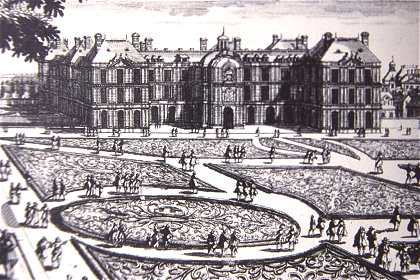
Palais du Luxembourg in the 17th century
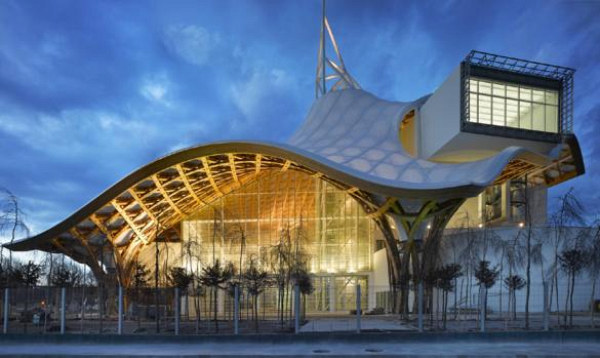
Centre Pompidou-Metz
The Centre Pompidou-Metz, which officially opened Wednesday, is one of a recent surge of “satellite museums” in what would seem to be a contemporary phenomenon.
Yet the desire to make use of collections otherwise confined to storage could arguably have emerged simultaneously with the idea of the modern French museum. In 1750, even before the Louvre was officially a museum, paintings from the royal collection “traveled” to the Luxembourg palace for public display, making “satellite museums” a historically grounded phenomenon with rather entangled political connotations. Andrew McClellan teases out the significance of the exhibition in the Luxembourg galleries in Inventing the Louvre. Put in place under Charles-Francois Lenormand de Tournehem, the director general of the Bâtiments du roi, McClellan writes:
Over and above the appeal of art as a vehicle of upward social mobility, Lenormand must have recognized in the Bâtiments post an opportunity to make his mark as a civil servant by effecting improvements in an area of government perceived as in need of reform.
Sarkozy, at the inauguration ceremony in Metz:
This museum, which is a strong cultural act, is at the same time an element of a strategic policy of economic development. … France believes in art and France believes that investing in a museum as extraordinary as this one is as important as investing in a university, in a laboratory, in nanotechnology.
Louis Petit de Bachaumont, who McClellan suggests likely proposed the idea for display in the Luxembourg galleries, was also one of the earliest proponents of art conservation; in the proposal submitted to King Louis XV it was noted:
And as they will be on display attention will be given to those in need of restoration. Appropriate restorations will be carried out under the supervision of the First Painter of the King.
The Pompidou similarly took the opportunity to restore works that would be on display in Metz, including Joan Miro’s Bleu triptych of 1961.
One distinction, of course, that has been repeatedly emphasized is that the Centre Pompidou Metz is not an outpost of the Centre Pompidou, but rather an independent entity, akin to a kunsthalle. The Louvre Lens, projected to open in 2012, will be used to showcase primarily Louvre works, albeit in radical curatorial configurations that will “abolish frontiers between techniques, schools or regions.”
‘Is Photography Over?’
by Jon Lackman | 14 May 2010 | Conferences, Photography
As a San Francisco Chronicle article noted, the SFMOMA recently hosted a symposium, “Is Photography Over?” Refreshingly, its website published the panelists’ statements and created a forum to extend the conversation and draw in more voices (W.J.T. Mitchell wrote, “I am a little grumpy about the premise of this symposium.”)
In the Chronicle, critic Kenneth Baker wrote:
Despite its taking place in SFMOMA’s auditorium, well-equipped to project images in any medium, no symposium participant showed a single picture … I found it troubling that no one seemed to want to get more specific … SFMOMA associate curator of photography Corey Keller acknowledged the symposium title question as “a blunt instrument,” intended to elicit wide-swinging responses. She suggested revising it to: “If something with photography is over, what is it?” Curator and New Yorker contributor Vince Aletti had the best – at least, the most direct – answer in his written statement. “What is over is the narrow view of photography – the idea that the camera is a recording device, not a creative tool, and that its product is strictly representational – not manipulated, not fabricated, not abstract …”
2 Comments
-
Travis Nygard said on 15 May 2010 at 1:45 am:
What do you all think are the most interesting and important books about photography published in the last decade or so? One of my favorites is The Beautiful and the Damned: The Creation of Identity in Nineteenth Century Photography by Peter Hamilton and Roger Hargreaves. It discusses how photography was used both as a fine art and to control people. http://www.worldcat.org/title/beautiful-and-the-damned-the-creation-of-identity-in-nineteenth-century-photography/oclc/48159961
-
Kathy Johnston-Keane said on 18 May 2010 at 1:14 am:
Michael Fried’s Why Photography Matters as Art as Never Before is reviewed in The Guardian and an interview appears in Art Review.
Digital Art History
by Jon Lackman | 13 May 2010 | Books, Conferences
In a recent issue of Art Documentation (28:2), Maureen Whalen warns that
Many studies have been conducted about the ill effects of being on the ‘wrong’ side of the digital divide. In the field of art history, it appears that the fetish for the printed book and a reluctance to incorporate digital technologies into the field of study are badges of honor rather than obstacles to be overcome. The field, however, is small with a greater supply of professionals than there are employment opportunities for them. Art history is only one discipline within the greater world of art. Visual cultural studies and new media art, while still somewhat in flux as disciplines, are capturing the interests of both students and publishers … [O]ne has to wonder just how bad it will get for art history scholars before the need to accept, adopt, and support electronic publishing emerges … The fundamental problems [with electronic publishing] are not permissions and color management, or even documentation that online distribution is faster, better, and/or cheaper. The real issue is the field’s leadership (or lack thereof) concerning experimentation with digital media and collaboration with others to maximize its usefulness to art history.
My impression is that, generally speaking, art historians have not cottoned to recent technology as enthusiastically as their counterparts in the humanities. That said, there is a European Science Foundation conference planned for October, “Networked Humanities: Art History in the Web,” that aims “to bring together art historians and other researchers (including digital humanists) in order to investigate the intersection between the web and collaborative research processes, via an examination of electronic media-based cooperative models in the history of art and beyond.” Invited speakers include Robert Stein of the Indianapolis Museum of Arts, who will talk on “Crowd-Sourcing Art History: Research and Application of Social Tagging for Museums”
3 Comments
-
L Rusch said on 14 May 2010 at 9:13 am:
Art Historians must get on the digital train for it will leave the station with out them. I am a digital alien teaching in world of digital native students ,we must engage them in multiple formats.
Scholars must share their information for the good of the dicipline, and in the spirit of collaboration. -
david packwood said on 14 May 2010 at 10:07 pm:
A timely warning.
I think such a conference is long overdue given the problems with disseminating research through print- the protracted nature of the process in general. -
Travis Nygard said on 15 May 2010 at 1:52 am:
My sense is that art historians in museums are ahead of those of us in colleges and universities. I am quite impressed with many of the thematic essays in The Heilbrunn Timeline of Art History, for example. This coming fall I am planning to use some of them to supplement textbooks in classes that I am teaching. http://www.metmuseum.org/toah/hi/te_index.asp?i=26
Illegitimate Art and a Raphael in the Basement
by Travis Nygard | 12 May 2010 | Books, Modern, Renaissance, Theory
I am fascinated by the systems through which art is deemed legitimate, and I taught a course on fakes and frauds this past January. The premise was that we can learn about how art is produced, controlled, and valued by focusing on taboo objects. Sometimes such scrutiny will result in a reattribution, such as the one announced last week in the Telegraph:
A portrait of a young woman, which had been dismissed as a fake Raphael and lay forgotten in the basement of an Italian palace for 40 years, has been confirmed as genuine by art experts and could be worth up to £25 million.
But I am more excited by “genuine” fakes. Perhaps the best book to date on this subject is Christopher Wood’s Forgery, Replica, Fiction. It argues that many of the questions of authenticity that we deem important today are modern inventions. If you have thoughts on great illegitimate art, please leave a comment.
2 Comments
-
Jon Lackman said on 18 May 2010 at 5:26 pm:
Apparently there is a new exhibition of Vermeer fakes, and The Telegraph reports that “A major Paris exhibition featuring forgeries and copies of works by Picasso, Matisse and other 20th century masters has been condemned by the artists’ heirs as “vampire” plagiarism that will encourage counterfeiting.”
-
Travis Nygard said on 26 May 2010 at 6:08 am:
A lengthier commentary on the Raphael painting is contained in the Three Pipe Problem. http://threepipeproblem.blogspot.com/2010/05/modena-madonna-raphael-resurfaces-in.html
‘a golden age for Ingres studies’
by Jon Lackman | 11 May 2010 | Books, Modern
Also in the April 2010 Art Newspaper, Christopher Riopelle considers Susan Siegfried’s Ingres: Painting Reimagined:
The past 15 years or so have been something of a golden age for Ingres studies. The central role that David played a generation ago in studies of the heroic origins of modern art has faded somewhat as scholars now explore their fascination with the more ambivalent and contradictory works of his leading students, Ingres among them … With Ingres, it seems, the ambiguities at the heart of the modern enterprise begin to become clearer. The strangeness of his art, his fascination with febrile psychological states and their exotic and erotic accoutrements, the inherent contradictions in what he had to say about his art and art in general, his singular failure to teach a new generation to be as greatly daring as he had been; all these issues serve to situate Ingres at the cusp of modernity along with his polar opposite, Courbet—it was Baudelaire who first linked them as the representative artists of the age. It is in this context that Siegfried’s handsome, densely argued new volume appears—the fullest, most penetrating account yet of our ongoing problem with Ingres.
Tenure, ho! Part I: The Grad-School App
by Oliver Shultz | 11 May 2010 | Career
[Editor’s Note: This is the first in a series of personal reflections by Oliver Shultz on the process of building a career in art history.]
Last December, I along with hundreds of other aspiring art historians sent our graduate-school applications out into the void. In the instant after clicking submit, I couldn’t help but wonder how few of us would actually succeed in forging careers as scholars. I felt a pang of solidarity with my competition – we hailed from diverse backgrounds yet sought to storm the same opaque gateways with similarly obsessed-over representations of our potential as scholars. We all imagined those representations passing through the fingers of mysterious committee-members, fated to be judged by the very scholars whose work we’d been studying and whose tenured professorships we hoped to one day possess.
With the anguished hours of compiling applications over, and left with nothing but automated confirmation emails, I began to process this temporary loss of control over my destiny. I felt both deflated and relieved. Now, the waiting began. I told myself that as an aspiring academic, I’d better get used to waiting to hear about life-changing decisions made with similar degrees of opacity– for fellowships, journal articles, conference slots, book proposals, not to mention jobs, and so on. But as the months passed, my dread escalated, fueled by the anxiety of fellow applicants and the dismal economy I hoped not to have to face.
I knew that with waitlists, purgatory sometimes lasts until mid-April, tempting one to obsessively check email and the online forums for news. Luckily for me, in February one of my favorite programs offered me a spot with funding. A few days later, my “two body problem” was solved, when my partner received a similar offer from her top choice, a nearby institution. This fall, we’ll begin our PhD programs simultaneously.
So while I’m both excited and nervous about embarking on my academic career, I’m keenly aware that while I cleared this hurdle, it may only have been by a thin margin and with considerable luck. We’ll never know. For me, unknowing is the essence of the whole affair, which is quite a way to start a career in the production of knowledge.
3 Comments
-
Leslie Thompson said on 11 May 2010 at 8:11 pm:
I like your idea for this series. I, too, recently applied for Ph.D. programs. Unfortunately, because of lack of funding, I wasn’t able to attend for the upcoming academic year. The lack of control I have over my art history/museum career makes me feel vulnerable.
I am definitely looking forward to reading your future reflections. -
Travis Nygard said on 13 May 2010 at 3:20 am:
It would be interesting to see recent statistics about job success in Art History rather than just hearing anecdotal experiences. Unfortunately the only major study that I know of was published in 2003—about the time that I started graduate school. It was done by the Center for Innovation and Research in Graduate Education and the Getty, titled PhDs in Art History – Over a Decade Later. It “surveyed all PhD recipients who graduated from US art and architectural history programs during the academic years 1985 to 1991.” Some of the major findings were quite encouraging. Even though these academics graduated right before the ression of the early 1990s, “nearly 100 percent of the respondents were employed 10 to 15 years after PhD completion, most of them in jobs related to their field of study.” The full text of this study remains online, and can be read here: http://depts.washington.edu/cirgeweb/c/wp-content/uploads/2008/02/arthistory_report.pdf
-
Jon Lackman said on 13 May 2010 at 5:29 pm:
I think that there are certain aspects of the experience that statistics will never capture, but I too wish we had more of them. I just emailed the center to try to find out if they plan to update their report. This general topic of what goes on behind closed doors in academic committees got a close look in Michèle Lamont’s recent book, How Professors Think: Inside the Curious World of Academic Judgment. Unfortunately, art history was not one of the fields she studied, but I found the book interesting anyway.
Ravenna, Caravaggio, Delacroix, Duchamp
by Ben Lima | 9 May 2010 | Ancient, Books, Modern
Recently in the papers:
- Stuart Ferguson reviews Ravenna in Late Antiquity, by Deborah Mauskopf Deliyannis
- Ingrid D. Rowland, “Radiant, Angry Caravaggio” [$]
- Julian Barnes on a new, 2,520-page edition of Delacroix’s Journal (“un document étonnamment complexe, hybride, chaotique, labyrinthique”)*
- Dalia Judovitz on her book Drawing on Art: Duchamp and Company
A New book on the Louvre’s 2nd Biggest Draw
by Jon Lackman | 7 May 2010 | Books, Renaissance
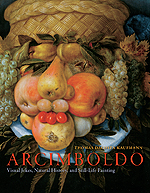
In the April 2010 issue of The Art Newspaper, Sylvia Ferino reviews Thomas DaCosta Kaufmann’s book Arcimboldo: Visual Jokes, Natural History, and Still-life Painting:
Since the most recent exhibitions devoted to Arcimboldo, in Paris and Vienna in 2007-8, his composite heads of “The Four Seasons” series, 1573, in the Louvre are said to have become that museum’s most popular paintings, second only to the Mona Lisa. This undoubtedly reflects the fact that Arcimboldo’s highly original creations appeal in the age of the “visual turn.” Further exhibitions are planned (at the National Gallery of Art, Washington, DC, and Palazzo Reale, Milan, in 2010-11) and promise to prolong this success …
Arcimboldo’s unique imagination still manages to captivate even visually jaded viewers. What is its secret? … [Kaufmann] is interested less in the artist, the concrete creative processes or the imagery than in revealing the sophisticated connections between these pictorial forms and descriptions of such phenomena in literature … His aim is to reconstruct the intellectual mood of the scholarly milieu that inspired the artist to produce these works … Over more than 300 pages, this elegantly illustrated book offers us an abundance of complex and elliptical reflections on art, nature, philosophy and poetry … What the book perhaps lacks is something of that trenchant irony Arcimboldo used when caricatured himself as a “man of letters” in a drawing where his face is composed of strips of paper.
1 Comment
-
EAG III said on 19 May 2010 at 12:40 am:
I was guessing Michelangelo.
Obviously not Monet, given the question.
Altering the Altarpieces
by Jon Lackman | 6 May 2010 | Conservation
Vasari’s “Last Supper” and the Ghent Altarpiece prepare to enter the conservation studio (thanks to the Getty) as the St Korbinian Altarpiece makes its exit.
The Ceiling
by Kelly Presutti | 6 May 2010 | Contemporary, Museums

Cy Twombly, The Ceiling, 2007-2009
A few people have already commented on Cy Twombly’s recently unveiled ceiling for the Louvre (here and here) – including one technically detailed letter that reveals a significant part of it was painted by a professor of art history!
Last night art historians Alex Potts (who has a forthcoming book on post-war art) and Richard Leeman (author of a monograph on Twombly and the Louvre publication on the ceiling) gave their thoughts. Potts insisted that the work – a vast expanse of painterly blue with hovering medallions and white bands containing the names of seven Greek sculptors from antiquity – is an “intelligent departure” from Twombly’s typical style, praising him for not simply enlarging his work to fit the space (as he hinted other artists creating large-scale public works were wont to do). He specifically noted the loss of texture and the unusual clarity of the writing as “honest responses to the demand” to create a work of such magnitude and prominence.
Leeman, however, pointed out several crucial points of congruence with Twombly’s earlier works, most notably the instability and uncertainty proper names carry – especially proper names as grand and mythic as those of the Greek sculptors; the presence of a father-son relationship between Praxiteles and Cephisodotus, the supposed name of both his father and his son; and the collage-like style, extending so far as to see an echo of scotch tape in the rectangular white bands, recalling Twombly’s important but little-known collage works.
Twombly himself, the first artist since Georges Braque to be invited to decorate a ceiling in the Louvre, remains laconic in his commentary,
I was just thinking of the blue with the disks on it, it’s totally abstract … I put all the great Greek sculptors’ names on the top. It’s that simple. [AP via USAToday]
3 Comments
-
Ben said on 7 May 2010 at 8:35 pm:
I wonder if Daniel Buren would be an example of one who “simply enlarges.” (1)
Looking through the exhibition catalog for Twombly’s Vienna exhibition, “States of Mind” recently, I was struck by how much of the varied work was permeated with moods of luxury, decadence, and aestheticism. One would never have imagined this range, if one knew only of the early works that are usually found in textbooks. I think this later material is actually more engaging and durable.
(1) https://studio360.wordpress.com/2010/01/18/can-art-and-football-mix/
-
Kelly Presutti said on 7 May 2010 at 11:23 pm:
I was surprised to see something so rich from Twombly as well – the blue is really ravishing (in the letter I linked to, the studio assistants joke, probably after International Klein Blue, that it should be called “Twomblu”).
It was also good to learn about his collages – and disappointing that there are apparently none in the Vienna show? The interest in collage along with the recognition of the crucial role scale plays seem to me to both be essential, under-examined factors in understanding even his more familiar works – something about the limits of the scope of illegibility and the layering of registers of form and meaning becomes more apparent.
-
Monica said on 8 May 2010 at 3:16 am:
This was a very timely post for me! This week I hav been researching more information about Twombly’s ceiling to show to my contemporary art students. Thanks for the latest up-to-date discourse on the topic. I especially love your link about Barbara Crawford, the art historian who helped Twombly paint.
Ruskin on Venice
by Ben Lima | 6 May 2010 | Architecture, Theory
Robert Hewison’s Ruskin on Venice has been reviewed by Steve Donoghue, Jonathan Glancey, Jonathan Wright, and Kevin Jackson. The productive tension between Ruskin’s Protestant moral sense, and his sensual affection for the visual arts, resulted in a distinctive prose variously termed “idiosyncratic,” “incomparable,” “magnificent,” and “gorgeous, insanely overwrought.”
3 Comments
-
Jon Lackman said on 6 May 2010 at 7:25 pm:
I find Ruskin stimulating on most any topic. I particularly recommend Modern Painters, which has great insights into art, even though he often seems much more interested such things in geology and cloud formation. His moral sense was indeed formidable, not just when it came to Whistler but also Canaletto (“The mannerism of Canaletto is the most degraded that I know in the whole range of art”) and indeed the whole of landscape painting: “And let it be understood that whenever hereafter I speak depreciatingly of the old masters as a body … I refer only to Claude, Gaspar Poussin, Salvator Rosa, Cuyp, Berghem, Both, Ruysdael, Hobbema, Teniers (in his landscapes), P. Potter, Canaletto, and the various Van somethings and Back somethings, more especially and malignantly those who have libelled the sea…. No doubt can, I think, be reasonably entertained as to the utter inutility of all that has been hitherto accomplished by the painters of landscape. No moral end has been answered, no permanent good effected, by any of their works … Landscape art has never taught us one deep or holy lesson; it has not recorded that which is fleeting, nor penetrated that which was hidden, nor interpreted that which was obscure; it has never made us feel the wonder, nor the power, nor the glory of the universe … That which ought to have been a witness to the omnipotence of God, has become an exhibition of the dexterity of man.”
-
david packwood said on 7 May 2010 at 4:48 pm:
I have a problem with Ruskin’s morality, especially when it gets out of hand and leads to daft pronouncements on Rosa, Guido Reni et al.
His importance to Venice was brought home to me by a chat with the guide of San Giobbe- a church that Ruskin admired for its architectural restraint- last month. The guide told me that Ruskin was very important to the Venetians because he wrote of a Venice that is no longer there.
-
Ben said on 7 May 2010 at 8:22 pm:
One reviewer mentioned Carlyle in comparison. As a non-19th-c-specialist, I’m taken aback by the impassioned, florid tone that is characteristic of both. I think it’s fair to say that most 20th-c. critics and historians don’t write this way. But I’m curious about why that is. Academic professionalization? An effort to emulate the exact sciences (neutrality, objectivity, etc.)? A need to be seen to be thoroughly demystified and self-critical, post Freud Marx Nietzsche?
I would actually be interested to read a review of Olafur Eliasson or the Burj Dubai that adopted a tone similar to the quotations below.
* * *
Ruskin:
Deep-hearted, majestic, terrible as the sea, – the men of Venice moved in sway of power and war; pure as her pillars of alabaster, stood her mothers and maidens; from foot to brow, all noble, walked her knights; the low bronzed gleaming of sea-rusted armour shot angrily under their blood-red mantle-folds.
http://www.openlettersmonthly.com/the-nautilus/
Carlyle:
Dance on, ye foolish ones ; ye sought not wisdom, neither have ye found it. Ye and your fathers have sown the wind, ye shall reap the whirlwind. Was it not, from of old, written : /The wages of sin is death/ ?
Obit: Anne Prache
by Jon Lackman | 6 May 2010 | Architecture, Medieval
A recent Bulletin Monumental (167-4) carries an obituary of Anne Prache (b. 1931), who died May 1, 2009. “A great figure in the history of art,” she was educated at the Ecole du Louvre and the Sorbonne, authored numerous books and articles, and eventually returned to the Sorbonne as professor of medieval art. She completed her doctorate in 1975, under Louis Grodecki, on the gothic sections of Saint-Rémi de Reims. It was published in 1978, “a reference work characterized by its balance of context … and deep architectural analysis.” She is credited with having resolved numerous longstanding controversies in the field of gothic architecture. A festschrift was dedicated to her in 1999, Pierre, lumière, couleurs. Etudes d’histoire de l’art du Moyen Age offertes à Anne Prache.
Art and Commerce
by Jon Lackman | 4 May 2010 | Contemporary, Journals
In a recent issue of Grey Room (n. 37), T.J. Demos writes
…. In the journal October, art historian and critic David Joselit raises the seeming contradiction of discovering art that is critical toward consumerism in the very site of the commercial art gallery … [However] the potential of the gallery as a site of critical contemplation, imaginative experimentation, and politicization cannot be dismissed … Rather than flatly dismiss art’s gallery-bound political ambitions as a trap, we must instead interrogate the very complexity of the situation … Against the caricature of the art institution as a mere commercial enterprise, we need to avoid the economic determinism that positions art as a passive effect of its patronage and reduces the meaning of aesthetics to an automatic function of its commercial context … Such facile identifications and binaries suggest precisely the kind of “partition of the sensible” of which Rancière speaks, “a distribution of the places and of the capacities or the incapacities attached to those places” that amount to so many “allegories of inequality.”
Forthcoming in Grey Room: “Ask Jeeves: Servants as Search Engines”
Obit: Avigdor Arikha
by Jon Lackman | 3 May 2010 | Uncategorized
From the Jerusalem Post:
[The artist Avigdor] Arikha was also an art historian and published books on Jean-Auguste-Dominique Ingres and on the art of painting (Peinture et regard, 1991, On depiction, 1995). He also acted as curator for several exhibitions, including exhibitions of Nicolas Poussin and Ingres at the Louvre in Paris. Also among his writings were catalogue articles for exhibitions at the Frick Collection in New York, the Museum of Fine Arts in Houston, and the Israel Museum.
(Arikha’s cv.)
1 Comment
-
David Packwood said on 4 May 2010 at 1:24 am:
I’m really sorry to hear this. I have his ‘On Depiction’ , including his essays on Poussin. I remember him getting excited at Poussin’s art back in the 1990s, the last great decade for exhibitions for this artist. I’ll do a small tribute on my blog.
Best- David

I too am looking forward to this exhibition, for the art and because I’m fascinated by all things related to Black Mountain College. It’s amazing how vibrant and influential a small place can become if the chemistry clicks, despite the barriers posed by low funds and a “provincial” location. By the by, I wouldn’t be surprised if we also see a Noland biography in the next few years. Five marriages, after all. Come to think of it, Robert Colescott and Saul Bellow had the same, all of them falling just one short of Norman Mailer’s six. Of course, writers and artists pale next to entertainers — Gloria Swanson, Larry King, Elizabeth Taylor, and Lana Turner all had even more. All that said, here’s hoping the Noland biography of the future will be mostly about the art!