Access to Information in Art History
by Travis Nygard | 2 May 2010 | Journals
I am fascinated by the state of publishing right now, as we are witnessing extreme polarization of access to information. Kelly just mentioned McGill University’s new journal SEACHANGE, which is part of the Open Access Movement. Free for all. No subscription needed. Instant online access.
More such journals are popping up all the time. The University of Pittsburgh, for example, has announced that it will start a new one called Contemporaneity: Historical Presence in Visual Culture. The editorial team is now taking submissions for the first issue. Others have been thriving for years. Indeed, the Directory of Open Access Journals lists 129 titles in Arts and Architecture. What do you think the best open access journals are in our discipline?
This movement seems to be thriving, in part, because many college and university libraries are cutting back on journal subscriptions. (One librarian friend tells me that subscription prices to journals, particularly online, have risen in price at 10% per year for the past decade … way above inflation.) We thus have a crisis of access, where only the wealthiest colleges and research universities are subscribing.
Schools that have embraced open access to information are particularly interesting to me. MIT is in the vanguard. In addition to theses and dissertations, all scholarly articles by MIT faculty must be made available for free online, in a database called Dspace. Exceptions require the approval of the administration. I believe that Harvard’s Faculty of Arts and Sciences now has a similar policy. I have not worked at such a school, but if any of you do please share your thoughts in the comments.
You may also be interested to know that MIT has a website that any scholar can use, regardless of institutional affiliation, to make an amendment to the publishing contracts that are sent to us all after our work has been accepted for printing. The goal of such an amendment is for you to retain the right to publish your articles on your personal website or contribute them to an online archive.
My understanding is that retaining such rights to make scholarship publicly accessible is becoming common in the sciences because of the legal requirement to make the results of publicly-funded scientific research publicly available. (PubMed started this trend.) Scholars in the humanities have been slower to make the results of research publicly available, but I suspect that we will do so more in the future.
2 Comments
The Face-To-Face
by Kelly Presutti | 1 May 2010 | Journals
The first issue of a new journal based at McGill University, SEACHANGE, was just made available electronically. Designed as a venue for creative, interdisciplinary scholarship,
its mission is to reconfigure inherited critical discourses in art, media, culture, and technology. Each individual issue is centred around a singular theoretical or affective event, formulated as an “intellectual moment” modeled on lived experience, where critical discourses react and readjust themselves.
Topics include Canadian-based Aboriginal new media art, the recent Tino Sehgal show at the Guggenheim, and interviews with Hans Haacke and art historian Amelia Jones.
Bestselling Recent Art Books
by Jon Lackman | 30 April 2010 | Books
Using Amazon’s advanced books search, you can get something of a sense for which recent art books are selling best. For books published since January, it seems to be:
1. Henri Cartier-Bresson: The Modern Century
2. Cartographies of Time: A History of the Timeline
3. Matisse: Radical Invention, 1913-1917
4. Otto Dix
5. Alice Neel
‘Constructing the Discipline: Art History in the UK’
by Jon Lackman | 30 April 2010 | Conferences, Theory
From Idearte:
The third annual Glasgow Colloquium on Art Historiography will be held in the Institute for Art History of the University of Glasgow 25th – 27th November 2010. Papers lasting 20 minutes are invited on formative moments, movements, institutions and individuals in accordance with the mission statement of the Journal of Art Historiography.
Seeing Red
by Jon Lackman | 30 April 2010 | Uncategorized
The Winter 2010 Metropolitan Museum of Art Bulletin is given over to a wonderful, amply illustrated article by Elena Phipps, “Cochineal Red: The Art History of a Color.” As Met director Thomas Campbell notes in his foreword, “Cultures the world over and throughout history have valued the color red,” and much of the world’s red has been cochineal red. “Cochineal, produced from the dried and pulverized bodies of a cactus-eating scale insect … quickly supplanted all other red dye-stuffs,” when Europeans “discovered” it in the 1520s in the Americas, where “Mexican and Andean weavers had for centuries been using it to create ritual and ceremonial textiles.” (Amy Butler Greenfield published a book on the substance in 2005, A Perfect Red.) Phipps based her article on years-long close study of Metropolitan Museum objects that use cochineal as well as her reading of the relevant literature. As she notes, her article “encompasses not just art and history but also geography, economics and science.” She notes for example that “the shipments from Lima to Spain in 1587 included 5,677 arrobas (about 144,000 pounds, or 72 tons) of cochineal,” forming an important part of the financing for the Spanish empire. Artists from Rembrandt to Van Gogh have made use of it, and of course it can be found today in everything from lipstick to salami.
Theoretical Archaeology Group Conference
by Jon Lackman | 28 April 2010 | Ancient, Conferences
From Brown University:
Brown University will host the Theoretical Archaeology Group from Friday, April 30 through Sunday, May 2, 2010. [This conference will address] the question of the place of archaeology – literally and figuratively. We have invited renowned scholars [Homi K. Bhabha, for example] from around the world to join with Brown faculty and students in exploring and debating this question over the course of the weekend – through conversation, presentations, performances, screenings, and exhibits. More than 300 conference participants are expected … with some 150 presentations planned.
The overarching theme of TAG 2010 is ‘The Location of Theory,’ and the conference is particularly noteworthy for its truly global scope. A delegation of Chinese archaeologists will be attending TAG for the first time … Several other sessions bring together scholars from a number of countries—from Iceland to South Africa to Palestine to Turkey—as well as archaeologists working right here in Rhode Island.
In other news, Brown was recently awarded
an $180,000 grant from the Getty Foundation to begin work on an international project titled “The Arts of Rome’s Provinces.” Twenty people with terminal degrees will be chosen to be a part of the project … Because art history is studied differently in each part of the world, the project will aim to “figure out how these different kinds of art histories can benefit each other” … the project [will be] a “movable feast” because the fellows will study Roman art history and archaeology in both Greece and England. The foundation approached [project co-directors] [Natalie] Kampen and [Susan] Alcock several years ago and asked if they would form a project to internationalize art history and apply for the grant.
Koerner Wins Mellon
by Jon Lackman | 28 April 2010 | Awards
Last month, Harvard art historian Joseph Leo Koerner was one of three scholars to receive an Andrew W. Mellon Foundation Distinguished Achievement Award. “Intended to underscore the decisive contributions the humanities make to the nation’s intellectual life, the awards, amounting to as much as $1.5 million each, honor scholars who have made significant contributions to humanistic inquiry.” Art historians Michael Fried, T.J. Clark, and Tom Gunning won the award in 2004, 2005, and 2008 respectively.
In other Mellon news, NYU’s Institute of Fine Arts (my institution) recently won a Mellon grant. According to the institute’s director, this grant will
support a three- to four-year project to examine the state of the field in art history, archaeology and conservation. The grant of $1,523,000 will enable us to convene a series of panels to examine advanced research in selected areas, asking where those fields are going, what the strengths are in given areas of study, what they require in terms of resources to pursue advanced research, how those resources are best managed, and how learning is best delivered in curriculum and training programs. The project will involve conferences, workshops, and invitations to Visiting Professors, who will act as panel chairs while offering courses at the IFA. There will be three two-year postdoctoral fellowships at the IFA in conjunction with the project, and we will also appoint a Research Activities Coordinator to oversee the management of the panels and to take over the arrangements for research-based activities (seminars, conferences, and lectures). The detailed planning phase is now underway and more information about the program and the fellowships should soon appear on the research pages of our website, so watch that space.
Who Pays for BHA?
by Jon Lackman | 27 April 2010 | Uncategorized
Apparently no one’s going to report on the recent art-bibliography conference in New York, alas. The L.A. Times art critic Christopher Knight has asserted that the Getty shouldn’t be expected to shoulder the BHA alone: “Outside LA, art folks commonly (& mistakenly) assume the Getty can & should pick up the tab for everything. Get over it.”
Given that we’re at this impasse, I’ll agree that all institutions with an interest in art-history research should look at each thing they’re doing and ask, is this more important than the BHA? To take one example, The Getty has apparently made a “large donation” to the Hollywood sign.
2 Comments
-
Travis Nygard said on 28 Apr 2010 at 8:40 pm:
I see this as part of a larger cultural problem and shift, where both scholars and librarians are abandoning traditional indexes in favor of full text searching (Google and JSTOR). While I do find the BHA useful in my own work at times, as someone interested in nontraditional approaches to visual culture I often find my key sources outside the BHA. It would be interesting to know who exactly is using this resource most heavily today, and if they are tied to institutions that could form a consortium.
As a side comment, I would also just like to point out that visual culture is notoriously difficult to index in an effective way.
-
Jeremy Miller said on 29 Apr 2010 at 5:43 am:
It seems to me that one fundamental question is whether the BHA is a basic and necessary resource that serves a general good, or if it is a specific tool only useful to a few people working in a non-essential field. It’s difficult to image what my research would have been, and would be, like without it. Probably slower and less comprehensive.
I would also suggest that the BHA’s primary uselfulness lies not in those who take a traditional approach to art history, but with those who study Western art between the Renaissance and Modernity. It is only a tool, with which one could build many different things.
Apollo’s new editor, Oscar Humphries
by Jon Lackman | 27 April 2010 | Journals
Apollo‘s new editor, Oscar Humphries, is profiled in The Telegraph:
Humphries follows a long line of qualified art historian editors, such as Denys Sutton, Anna Somers Cocks, David Ekserdjian and, most recently, Michael Hall. His background, however, is more in the field of the art trade … and journalism … As such, he is probably an unknown quantity to the magazine’s scholarly advisory board – including museum directors Mark Jones (V&A), Jeremy Warner (Wallace Collection) … [Humphries has said] that Apollo would “not become a contemporary art magazine, but a contemporary magazine.”
Humphries aims to make Apollo more accessible and to add coverage of contemporary art. According to The Evening Standard and The Art Newspaper, Humphries, “a long-time dandyish figure on the gallery circuit,” will “continue working for London’s Timothy Taylor Gallery where the 28-year-old is set to co-curate an exhibition of 1950s European art and design this summer.”
Siena, Lotto, Palladio
by Ben Lima | 25 April 2010 | Architecture, Renaissance
Three recent reviews and essays on the Renaissance: Colm Tóibín on the stubbornness of Lorenzo Lotto, Rachel Spence on early Renaissance art in Siena, and Nicolai Ouroussoff on “Palladio and His Legacy” at the Morgan Library.
Neo Rauch
by Ben Lima | 24 April 2010 | Contemporary, Museums
Neo Rauch, central figure in the so-called Leipzig School of German painting, observes his fiftieth birthday with a double retrospective in Leipzig and Munich. The catalog is from Hatje Cantz.
‘Travelling in a Palimpsest’
by Jon Lackman | 23 April 2010 | Books, Modern
It doesn’t get much more multicultural than this: an English-language book titled Travelling in a Palimpsest: Finnish Nineteenth-Century Painters’ Encounters with Spanish Art and Culture. It’s by Marie-Sofie Lundström and Clara Marcellán reviews it (in Spanish) in the Jan-Mar 2010 issue of Goya (“una exhaustiva reconstrucción”).
Bernardo De Dominici’s ‘Vite’
by Jon Lackman | 22 April 2010 | Books
In the January 2010 Burlington Magazine, Erika Langmuir reviewed the new edition of Bernardo De Dominici’s 1742 Vite de’ Pittori, Scultori ed Architetti Napoletani edited by Fiorella Sricchia Santoro and Andrea Zezza:
This is a heroic editorial enterprise, that restores to Bernardo De Dominici’s ambitious oeuvre … the dignity it deserves without, however, minimising those aspects of invention and forgery that made the author a butt of scholarly reprobation in his own lifetime, and the publication a commercial failure … [It] provides a trustworthy guide to a fascinating document at a significant moment of eighteenth-century European culture.
Manierre Dawson, Abstraction Pioneer?
by Jon Lackman | 21 April 2010 | Americas, Modern
A catalogue raisonné will appear this fall for the early American abstract artist Manierre Dawson. According to its author, Randy Ploog, Dawson
had never traveled further than Michigan, had no contact with progressive artists in Europe, New York or even his native Chicago … What prompted this young civil engineer to produce these groundbreaking paintings has been one of the great mysteries of modern American art … According to conventional histories, modernism, including non-representational abstraction, originated in Europe and spread to the United States. But Ploog points out that Dawson’s paintings of April-June 1910 defy this accepted canon. “Every attempt to link Dawson’s paintings to his European contemporaries has proven unsuccessful,” Ploog said. “Consequently, art historians have not known how to explain his early accomplishments. For this reason alone his work has not received the recognition it deserves.”
Archaeology Book Reviews
by Jon Lackman | 21 April 2010 | Ancient, Journals
As editor Naomi Norman explains in the January 2010 issue, the American Journal of Archaeology has added much more color to its pages and it has moved all of its book reviews online, where they can be read free of charge. Also online: exhibition reviews and a limited selection of journal content. (Off topic: It seems worth noting that presently five of the journal’s top six editors are women, surely a departure from AJA’s past.)
Les Promesses du Passé
by Kelly Presutti | 21 April 2010 | Books, Contemporary, Museums
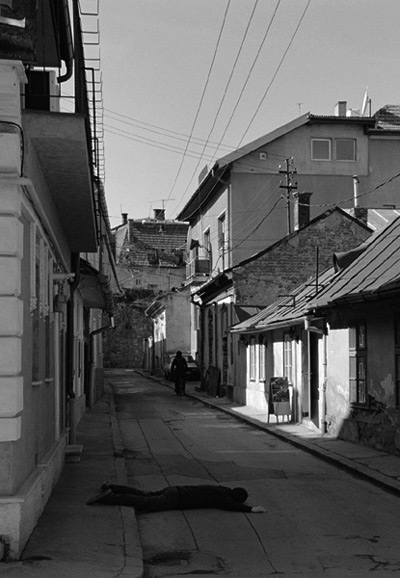
Ciprian Muresan, Leap into the void - after three seconds, 2004
Prompted by the opening of Les Promesses du Passé at the Centre Pompidou, some recent work on post-Wall “Eastern European” art (one of the tenets of the exhibition is to demonstrate the irrelevance of this term in light of the polyphony of voices; the exhibition layout is designed to be discontinuous, accordingly):
Transitland is a “collaborative archiving project” with 100 single-channel video works produced between 1989 and 2009 in Central and Eastern Europe. A related publication is also available.
The papers collected in Mel Jordan and Malcom Miles’ Art and Theory After Socialism, written by politically engaged artists, critics and curators, provide both theoretical and practical accounts of recent and contemporary art from Armenia, Germany and the United Kingdom. Miles writes in the introduction:
For want of a better term, the condition of post-socialism… indicates European culture after the demise of state socialist regimes in the East bloc while, I would argue, socialism as an ideology is not erased by the failure of state socialist regimes. The book offers a series of specific windows on this field.
In Victor Tupitsyn’s The Museological Unconscious he defines a “communal optic” as requisite lens for viewing Russian contemporary art:
Tupitsyn argues that socialist realism does not work without communal perception—which, as he notes, does not easily fit into crates when paintings travel out of Russia for exhibition in Kassel or New York. Russia, he writes, went through an immense “optical restructuring” in the 1930s, in which viewers of art were “communalized.” … Russian artists, critics, and art historians, having lived for decades in a society that ignored or suppressed avant-garde art, have compensated, Tupitsyn claims, by developing a “museological unconscious”—the “museification” of the inner world and the collective psyche.
Art Power, by Boris Groys, argues for “for the inclusion of politically motivated art in contemporary art discourse” noting that art
is produced and brought before the public in two ways—as a commodity and as a tool of political propaganda. In the contemporary art scene, very little attention is paid to the latter function; the official and unofficial art of the former Soviet Union and other former Socialist states, for example, is largely excluded from the field of institutionally recognized art, usually on moral grounds (although, Groys points out, criticism of the morality of the market never leads to calls for a similar exclusion of art produced under market conditions).
For more, see Art Margins, which offers book reviews, articles, artwork and interviews focused on Central and Eastern Europe.
The Accademia di San Luca Seminars
by David Packwood | 20 April 2010 | Books
Amongst the many topics covered in The Accademia Seminars: The Accademia di San Luca in Rome, c. 1590-1635 (2009), the second volume of seminar papers from the Centre for Advanced Research in the Visual Arts (CASVA), are the following: the function of notaries within the Accademia, the relationship between philosophy, painting and academic theory, and the teaching structure of the organization. Each of the 12 essays may be seen as a window of opportunity for scholars working on the artistic and institutional culture of early modern Rome. For me, several essays suggest ways of enhancing my own research on such problems as the teaching of anatomy in Rome around 1600. I’d like to know more about the overlapping of medical centres and artistic spaces, a topic flagged up in essays by Julian Brooks and Frances Gage. I also found Laurie Nussdorffer’s essay on the intersection of notaries and the congregations of painters suggestive because it throws light on an aspect of academic culture that has been ignored – scribal practices and the business affairs of painters.
The volume has not been created for a narrow band of scholars though – a wider audience is envisaged, including members of the general public. This is what makes the whole project so deserving of praise, the dissemination of cutting edge ideas and research to those outside a small circle of academic friends.
2 Comments
-
Jonathan Lackman said on 21 Apr 2010 at 1:10 am:
According to CASVA, this Thursday there will be a presentation by Peter M. Lukehart (among others), project director of The Accademia Seminars and the related website “The History of the Accademia di San Luca, c. 1590–1635: Documents from the Archivio di Stato di Roma”.
3:30 p.m., Lecture Hall, Bard Graduate Center, 38 West 86th Street, New York, NY 10024. Register with [email protected] or call (212) 501-3019.
-
davidpackwood said on 21 Apr 2010 at 1:23 am:
Ok Jonathan- thanks for that- David
Obit: Rosalinde Gregor Wilcox
by Jon Lackman | 20 April 2010 | Africa
A recent issue of African Arts (Winter 2009) carries an obituary of Rosalinde Gregor Wilcox, a scholar of African art who earned her PhD from UCLA in 1994, at the age of 58, after studying with Arnold Rubin, Herbert Cole, and Doran Ross:
She was critically aware but cautious in her writing. The canoe prows of the Cameroon coastal communities exercised her intellectual horizons, over and over again. In an African Arts essay she examined the transregional importance of the canoe for commerce and communication, drawing on the history and aesthetics of the prows as a metaphor for movement and contact … Rosalinde was cryptic and very succinct [in conversation] … ‘Earnest, as impure as the driven snow’ … ‘He’s a nice fellow, with limiting reservations.’
Bibliography In The 21st Century
by Leslie Thompson | 19 April 2010 | News
The shaky future of the Bibliography of the History of Art.
In the meantime, since April 1, the Getty has announced it would offer free public access to the bibliography through its website.
2 Comments
-
Sarah Beth Wilson said on 19 Apr 2010 at 11:44 pm:
AWESOME. That’s my comment.
-
Jonathan Lackman said on 20 Apr 2010 at 6:02 am:
For more, see this WSJ article by Lee Rosenbaum as well as her blog.
Touching Art: Video Paintings
by Leslie Thompson | 19 April 2010 | Contemporary, Museums
With the integration of technology and electronic media in art, new issues in contemporary art continue to arise. A recent encounter with such type art has raised a particular question for me.
The Modern Art Museum of Fort Worth currently has on view a FOCUS show of American-born artist Ben Jones:
Jones’ work investigates new methods of pictorial storytelling in the digital age. An interdisciplinary artist working in video, sculpture, painting, light painting and drawing, his artworks and installations evoke environments and themes both familiar and bizarre.
In one of the galleries hangs MS Video Painting II, 2010 (canvas, gouache, DVD), a canvas painted in a somewhat op art fashion with stripes and flat shapes , a completed work in itself. Suspended opposite the canvas is a projector that projects moving designs in light, altering the appearance of the painted composition. Thus the canvas becomes a different work of art. (Edit: Both images courtesy of Amanda Potter’s iPhone.)
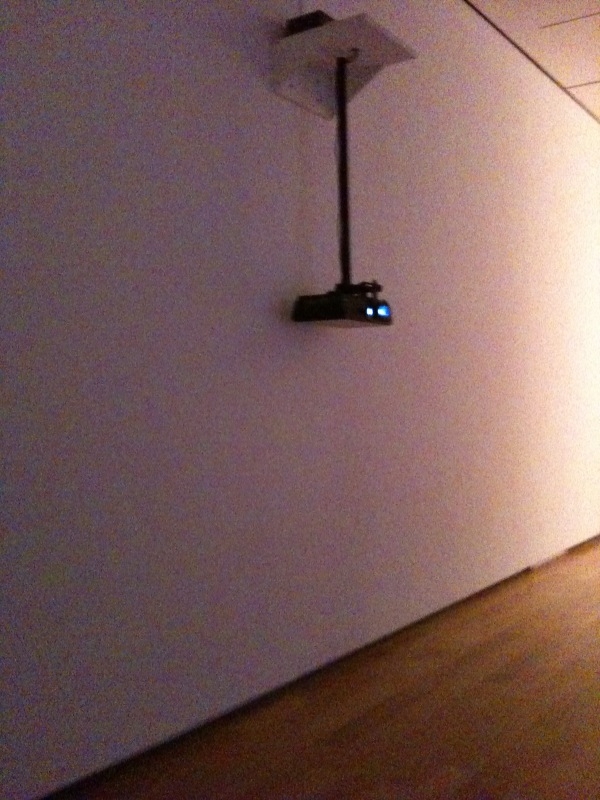
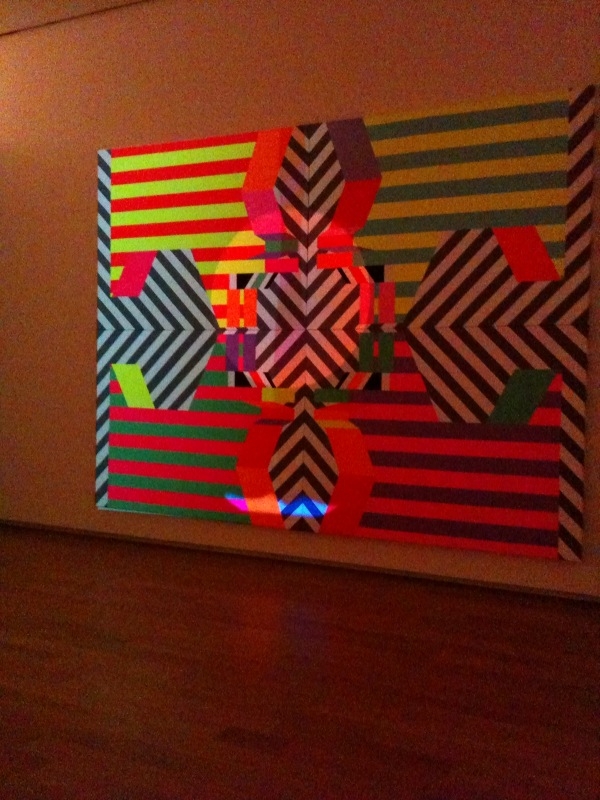
Now, most museum collections are not for touching. (Although within the last several years, the visually disabled have challenged these restrictions to allow a multi-sensory experience.) Some artwork relies on the viewer’s participation, as with the growing phenomenon of interactive art. Yet, with this particular piece, if one were to block the light from the projector, whether intentionally or accidentally, one would be changing the composition, altering the entire piece. While the viewer is not physically contacting the painting, is he/she still considered to be touching the art? Where are the boundaries in such work?
3 Comments
-
Sarah Beth Wilson said on 19 Apr 2010 at 11:32 pm:
I really want to see this and will definitely include a stop by the modern next time I’m in DFW. Not sure what I think regarding your question. I guess my first response is to not think of it so much as “touching” the art, or crossing any boundaries, but as more becoming part of the work and activating the space. Once again, I really want to see the piece and installation to fully understand Jones’ set up. It makes me think of a work I saw at the Menil here in Houston not long ago, a video installation in one of the contemporary galleries. I can’t recall the artist, but basically there was a video projector set up in the middle of the gallery. Everyone kept looking around trying to figure out where the image was being projected or basically what was going on. Then a guard pointed out that you have to stand in this one corner, then the image is projected onto you, in this case it was text I think. So basically, the work of art is not even visible without human interaction, human touching. Just an interesting comparison to your comments regarding touching, boundaries, etc with Jones’ work. And I’m curious regarding your use of the term “boundaries” in your post. Do you mean this in reference to the “don’t touch art” aspect of museums, or in reference to who / what is the art work and who has control in changing / altering the final product?
-
Leslie Thompson said on 19 Apr 2010 at 11:42 pm:
The piece you encountered sounds like interactive art, whereas Jones’ piece does not intend for viewer interaction.
When I question the boundaries in this artwork, what I’m refering to are the boundaries in terms of physical touching vs. virtual(?) touching. A viewer can stand under the projector, lift up their hand and block the light composition, leaving just the physically painted composition. But then the entire piece has changed. The projected light design is part of the artwork. This is definitely a question of “touching” of some sort. I do not feel that the artist intended for the viewer to play with the projection. It works on its own.
Hopefully I can post images soon to provide a better picture of the issue.
-
Sarah Beth Wilson said on 19 Apr 2010 at 11:48 pm:
Yeah, I really want to see images. Need to get up there to see it. So by the installation it appears that Jones did not intend for the viewer to alter the projection? I assume this particular piece is what he refers to as his light paintings? It’s interesting to consider the artist’s background in animation as well, considering that animation involves the combination of a hand-made image with video / light projection.

“Indeed, the Directory of Open Access Journals lists 129 titles in Arts and Architecture.”
/cough/ A lot more here…
http://www.jurn.org/directory/
Another aspect of the proliferation of journals is that more work, on more subjects, from more diverse and experimental voices, is being published. Might this lead to a resurgence of the more impassioned tones Ben mentions in his comment on this Ruskin post /blog/?p=1524 ? Newer journals certainly evade the tendency to conform one’s writing to an established journal’s entrenched style (cf the well-known parody “November”).